
Buying Guide
The Best Studio Monitors Under $2000
From the BX3 to the HS5: five speakers ranked on woofer size and form, with who should skip each one.
By The PC Journal editorial team
12 min read5 products evaluated
A $2000 ceiling rules out the premium models, which makes the differences between the rest matter more. Every monitor pair here cost $2000 or less when we checked and is a studio monitor, ordered from the lowest price.
This is a research roundup, not a lab test: form, woofer size and inputs come from each maker's published specs; nothing here was tested in-house, and a missing inputs is flagged, not filled in.
Quick Picks
Our 5 recommendations at a glance. Tap a pick for the full verdict.

Lowest Price Here
M-Audio BX3 Studio Monitors (pair)
The lowest price of the group at our last check.
Best for: Keeping the budget tight.
Our take Check price for M-Audio BX3 Studio Monitors (pair) (opens in a new tab)

Also Consider
JBL 305P MkII Studio Monitor (single)
A boundary EQ that corrects bass near walls or on a desk.
Best for: Buyers who want boundary EQ that corrects bass near walls or on a desk.
Our take Check price for JBL 305P MkII Studio Monitor (single) (opens in a new tab)

Strong Alternative
PreSonus Eris 3.5 Studio Monitors (pair)
50 watts of built-in amplification.
Best for: Buyers who want 50 watts of built-in amplification.
Our take Check price for PreSonus Eris 3.5 Studio Monitors (pair) (opens in a new tab)
Worth a Look
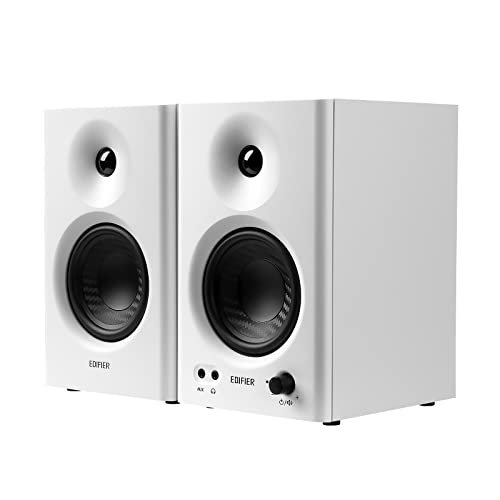
Edifier MR4 Studio Monitors (pair)
A near-flat response tuned for music creators.
Best for: Buyers who want near-flat response tuned for music creators.
Our take Check price for Edifier MR4 Studio Monitors (pair) (opens in a new tab)

Premium Pick
Yamaha HS5 Studio Monitors (pair)
The top of this price range, adding a 54Hz to 30kHz frequency response.
Best for: Spending more for the fullest feature set.
Our take Check price for Yamaha HS5 Studio Monitors (pair) (opens in a new tab)
Our Picks
Lowest Price Here1 of 5
M-Audio BX3 Studio Monitors (pair) on Amazon (opens in a new tab)
The BX3 pair is the smaller 3.5-inch version of M-Audio's desktop monitors, with Kevlar woofers and silk-dome tweeters.
Best for
- Keeping the budget tight.
Skip if
- Look at the others if this bothers you: woofer size of 3.5-inch, behind the 305P MkII (5-inch).
Why we like it
It is an affordable step up from computer speakers for basic mixing. It connects over a wired link, so there is no Bluetooth delay while monitoring. It is a compact first pair for a small desk.
Its bi-amplified design separates the woofer and tweeter amps for cleaner output. It matches the Eris 3.5 on woofer size (3.5-inch). You also get a wired, zero-latency connection.
It was the cheapest of the group when we checked; the 305P MkII was the next step up. The main gap: woofer size of 3.5-inch, behind the 305P MkII (5-inch). If that matters, the 305P MkII comes in at 5-inch.
Key dimensions & specs
- Form: Studio monitor pair
- Woofer size: 3.5-inch
Pros
- Kevlar woofers with silk-dome tweeters
- Wired, zero-latency connection
- The lowest price of the group at our last check
Cons
- Woofer size of 3.5-inch, behind the 305P MkII (5-inch)
Also Consider2 of 5
JBL 305P MkII Studio Monitor (single) on Amazon (opens in a new tab)
The 305P MkII is a single 5-inch monitor with a boundary EQ that corrects bass when it sits on a desk or near a wall.
Best for
- Buyers who want boundary EQ that corrects bass near walls or on a desk.
Skip if
- Price-first buyers should look at the BX3, which cost less when we checked.
Why we like it
JBL runs each unit through a 100-hour full-power test. It is sold as a single speaker, so budget for two. Its Slip Stream port extends bass at low listening volumes.
Its updated transducers aim for lower distortion and a tighter transient response. It suits a nearfield desk setup. It is known for a neutral voicing at this price.
It has XLR and TRS inputs with a +4dBu/-10dBV switch, and its Class-D amps deliver 82 watts. On woofer size it ties with the HS5 at 5-inch. It was priced above the BX3 and below the Eris 3.5 at the time of writing.
Key dimensions & specs
- Form: Single studio monitor
- Woofer size: 5-inch
Pros
- Boundary EQ that corrects bass near walls or on a desk
- Slip Stream bass port
- 100-hour full-power test on each unit
- Woofer size of 5-inch, ahead of the MR4
Cons
- Costs more than the BX3 at the time of writing
Strong Alternative3 of 5
PreSonus Eris 3.5 Studio Monitors (pair) on Amazon (opens in a new tab)
The Eris 3.5 is a compact studio monitor pair with 50 watts of amplification and acoustic tuning controls.
Best for
- Buyers who want 50 watts of built-in amplification.
Skip if
- Skip it if woofer size matters most to you; the 305P MkII offers 5-inch.
Why we like it
It suits a small desk, though 3.5-inch woofers limit how low it can reach. Its tuning controls help in untreated rooms. Its 80Hz to 20kHz range covers vocals and most instruments at desk distance.
Its 1-inch silk-dome tweeters smooth out harsh highs. Its compact cabinets fit beside a monitor on a small desk, and the pair includes the cables to connect them. It has balanced TRS, RCA and a front aux input plus a headphone jack.
Its 3.5-inch woven-composite woofers give tighter bass than typical desk speakers of this size. When we checked, only the 305P MkII and cheaper picks cost less, and the MR4 cost more. Woofer size is its weakest area, and the 305P MkII covers it better at 5-inch.
Key dimensions & specs
- Form: Studio monitor pair
- Woofer size: 3.5-inch
- Extras: High and low acoustic tuning controls
Pros
- 50 watts of built-in amplification
- 1-inch silk-dome tweeters
- 80Hz to 20kHz frequency range
Cons
- Woofer size trails the 305P MkII (5-inch)
- Costs more than the BX3 at the time of writing
Worth a Look4 of 5
Edifier MR4 Studio Monitors (pair) on Amazon (opens in a new tab)
The MR4 pair is tuned to a near-flat response for mixing but switches to a music mode for everyday listening.
Best for
- Buyers who want near-flat response tuned for music creators.
Skip if
- If budget leads, the BX3 was cheaper at our last price check.
Why we like it
It has TRS, RCA and AUX inputs and a front headphone jack. Edifier tunes them to a near-flat curve with 1-inch silk dome tweeters and 4-inch woofers in MDF cabinets. On woofer size it sits mid-pack at 4-inch: the 305P MkII comes in at 5-inch, and the Eris 3.5 comes in at 3.5-inch.
It also offers a switch between monitor and music modes. Before buying, weigh one limit: costs more than the BX3 at the time of writing. It was priced above the Eris 3.5 and below the HS5 at the time of writing.
Key dimensions & specs
- Form: Studio monitor pair
- Woofer size: 4-inch
- Inputs: TRS, RCA and AUX
Pros
- Near-flat response tuned for music creators
- Front headphone output
- Switch between monitor and music modes
- Woofer size of 4-inch, ahead of the BX3
Cons
- Costs more than the BX3 at the time of writing
Premium Pick5 of 5
Yamaha HS5 Studio Monitors (pair) on Amazon (opens in a new tab)
The HS5 pair is Yamaha's near-field monitor, known for a voicing that aims for uncoloured sound.
Best for
- Spending more for the fullest feature set.
Skip if
- Price-first buyers should look at the BX3, which cost less when we checked.
Why we like it
Each speaker has a 45W plus 25W bi-amp and XLR and TRS inputs. The pair are two-way bi-amplified near-field monitors with 5-inch woofers and 1-inch dome tweeters. Yamaha tunes them to reproduce sound without added colour.
On woofer size it ties with the 305P MkII at 5-inch. It also comes with a 54Hz to 30kHz frequency response. Before buying, weigh one limit: costs more than the BX3 at the time of writing. At our last price check it topped the group, with the MR4 the nearest cheaper option.
Key dimensions & specs
- Form: Studio monitor pair
- Woofer size: 5-inch
- Inputs: XLR and TRS
Pros
- 54Hz to 30kHz frequency response
- 45W plus 25W bi-amp system per speaker
- Voicing aimed at uncoloured sound
- Woofer size of 5-inch, ahead of the MR4
Cons
- Costs more than the BX3 at the time of writing
How We Chose These Studio Monitors Under $2000
Each pick was assessed across 4 criteria weighted for real-world use.
- How these picks were ranked
- We set side by side five speakers on form, woofer size and inputs from manufacturer specifications. We did not test them in-house.
- The shared baseline
- All 5, from the BX3 to the HS5, state form and woofer size.
- Where the specs have gaps
- The BX3, the 305P MkII and the Eris 3.5 give no inputs.
- Price range
- At our last check the picks ran from the BX3 ($50 to $100) to the HS5 ($250 to $500).
What to Look for in a Studio Monitor Under $2000
Key buying criteria so you get the right fit the first time.
Woofer size across these picks
Here woofer size runs from 3.5-inch on the Eris 3.5 to 5-inch on the 305P MkII. The 305P MkII is the pick for woofer size.
Features beyond the spec table
The Eris 3.5: 1-inch silk-dome tweeters. The MR4: a front headphone output. The HS5: a 45W plus 25W bi-amp system per speaker.
How much to spend
$50 to $100 buys the BX3, the 305P MkII and the Eris 3.5; $150 to $250 buys the MR4; $250 to $500 buys the HS5 at our last check.
Match the pick to your priority
Keeping the budget tight: the BX3. Spending more for the fullest feature set: the HS5.
Soundbar or stereo pair
A soundbar sits under a monitor and saves desk width. A stereo pair spreads the sound wider and usually fills a room better at the same price.
How to Choose a Studio Monitor Under $2000
By priority
| Priority | Consider | Why |
|---|---|---|
| Keeping the budget tight | BX3 | The lowest price of the group at our last check |
| Buyers who want boundary EQ that corrects bass near walls or on a desk | 305P MkII | A boundary EQ that corrects bass near walls or on a desk |
| Buyers who want 50 watts of built-in amplification | Eris 3.5 | 50 watts of built-in amplification |
| Buyers who want near-flat response tuned for music creators | MR4 | A near-flat response tuned for music creators |
| Spending more for the fullest feature set | HS5 | The top of this price range, adding a 54Hz to 30kHz frequency response |
Scroll sideways to see every column.
Key specs side by side
The 305P MkII leads on woofer size at 5-inch, ahead of the HS5 at 5-inch. "Not listed" means the maker leaves that figure out.
| Speaker | Form | Woofer size | Inputs |
|---|---|---|---|
| BX3 | Studio monitor pair | 3.5-inch | Not listed |
| 305P MkII | Single studio monitor | 5-inch | Not listed |
| Eris 3.5 | Studio monitor pair | 3.5-inch | Not listed |
| MR4 | Studio monitor pair | 4-inch | TRS, RCA and AUX |
| HS5 | Studio monitor pair | 5-inch | XLR and TRS |
Scroll sideways to see every column.
By price at the time of writing
The BX3 was the lowest-priced pick and the HS5 the highest when we checked; tiers move with Amazon pricing.
| Price tier | Speakers |
|---|---|
| About $50 to $100 | BX3, 305P MkII, Eris 3.5 |
| About $150 to $250 | MR4 |
| About $250 to $500 | HS5 |
Frequently Asked Questions
Is the HS5 worth paying more than the BX3?
On paper it adds woofer size (5-inch against 3.5-inch). The BX3 was the lowest-priced pick when we checked, so pay the difference only if those gains matter to you.
What makes the BX3 the Lowest Price Here?
It earns the label for the lowest price of the group at our last check. It suits keeping the budget tight.
Beyond the specs, what sets the BX3 and the 305P MkII apart?
The BX3: Kevlar woofers with silk-dome tweeters. The 305P MkII: a boundary EQ that corrects bass near walls or on a desk. The Eris 3.5: 50 watts of built-in amplification.
Who should choose the HS5?
The HS5 carries our Premium Pick label for the top of this price range, adding a 54Hz to 30kHz frequency response. It ranks fifth of 5 here.
Should I pick the BX3 or the HS5?
The BX3 suits keeping the budget tight; the HS5 suits spending more for the fullest feature set.
Bottom Line
Our first pick is the BX3, chosen for the lowest price of the group at our last check. Look at the 305P MkII for a boundary EQ that corrects bass near walls or on a desk, the Eris 3.5 for 50 watts of built-in amplification and the MR4 for a near-flat response tuned for music creators if those matter more to you.
Place monitors at ear height, angled toward your head.