
Buying Guide
The Best PC Speakers for Your Desk
Six desktop speaker sets, from USB-powered Creative Pebbles to Edifier bookshelf pairs and a THX-certified Klipsch 2.1 system.
By The PC Journal editorial team
12 min read6 products evaluated
PC speakers fall into three groups: small USB-powered pairs that run from the computer, bookshelf pairs with their own power supply and more inputs, and 2.1 sets that add a subwoofer for bass. The right group depends on desk space and whether you also want to play music from a phone or TV.
We compared six sets using the specifications in their Amazon listings. We did not test them, and we keep peak and RMS power figures separate because makers quote them differently.
Quick Picks
Our 6 recommendations at a glance. Tap a pick for the full verdict.
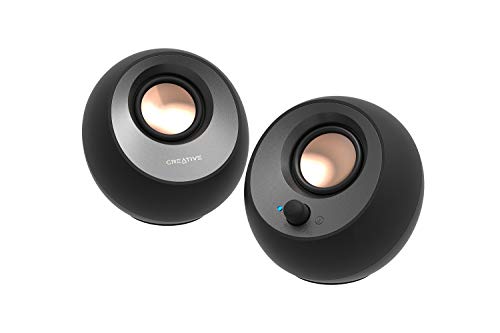
Best Single-Cable Setup
Creative Pebble V3 USB-C Desktop Speakers
USB-C power and audio on one cable, with Bluetooth 5.0 and 3.5mm as alternatives.
Best for: Small desks and laptops docked at a monitor.
Our take Check price for Creative Pebble V3 USB-C Desktop Speakers (opens in a new tab)

Best Compact Bass
Creative Pebble Pro USB-C Desktop Speakers
BassFlex tuning with a 20W peak from USB-C power.
Best for: Compact desks that still want fuller bass.
Our take Check price for Creative Pebble Pro USB-C Desktop Speakers (opens in a new tab)

Best Budget 2.1
Logitech Z313 2.1 Speaker System with Subwoofer
A compact subwoofer and a wired control pod.
Best for: Adding bass on a tight budget.
Our take Check price for Logitech Z313 2.1 Speaker System with Subwoofer (opens in a new tab)
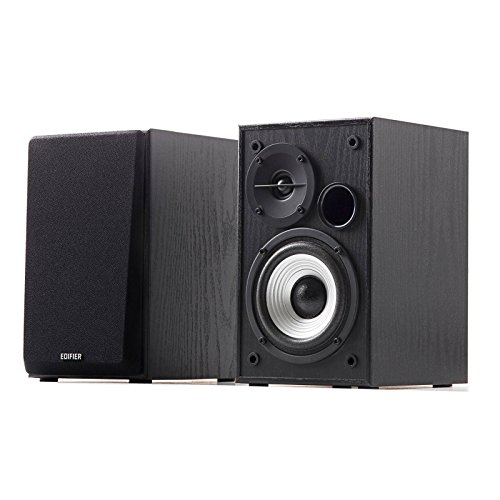
Best Wired Bookshelf Pair
Edifier R980T Active Bookshelf Speakers
Wooden enclosures and two AUX inputs usable at the same time.
Best for: A PC and a second source on one pair of speakers.
Our take Check price for Edifier R980T Active Bookshelf Speakers (opens in a new tab)
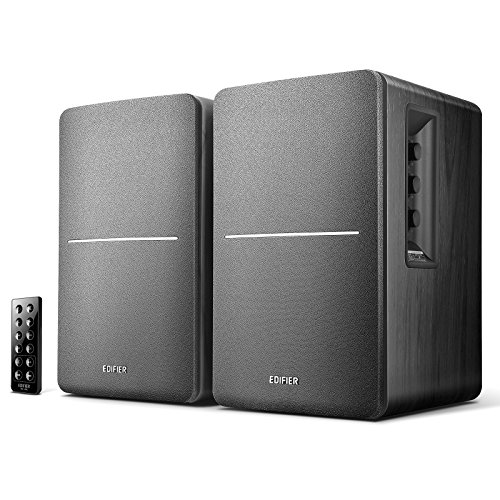
Most Inputs
Edifier R1280DB Powered Bluetooth Bookshelf Speakers
Bluetooth, optical, coaxial and AUX inputs with a remote.
Best for: Desks that share speakers between a PC, a phone and a TV.
Our take Check price for Edifier R1280DB Powered Bluetooth Bookshelf Speakers (opens in a new tab)

Highest Listed Peak Power
Klipsch ProMedia 2.1 THX Certified Computer Speakers
A 200W peak with a 6.5in side-firing subwoofer and THX certification.
Best for: Games and films at room-filling volume.
Our take Check price for Klipsch ProMedia 2.1 THX Certified Computer Speakers (opens in a new tab)
Our Picks
Best Single-Cable Setup1 of 6
Creative Pebble V3 USB-C Desktop Speakers on Amazon (opens in a new tab)
Creative's Pebble V3 runs on a single USB-C cable for power and sound, with Bluetooth 5.0 and a 3.5mm input as alternatives.
Best for
- Small desks and laptops docked at a monitor.
Skip if
- Choose another pick if you can't accept this: no subwoofer, so deep bass comes only from the main drivers.
Why we like it
Its 2.25in drivers angle up at 45 degrees toward the listener, and a gain switch adds volume. Its 2.25-inch drivers are 50% louder than the previous Pebble, and Clear Dialog processing helps speech in calls and films. It also connects over Bluetooth 5.0 or a 3.5mm input, and its drivers angle up 45 degrees toward your ears.
Its 2.25-inch drivers are 50% louder than the previous Pebble, and one USB-C cable carries power and audio. Bluetooth adds some delay, so use a wired input for games. It cost the least of the 6 picks at the time of writing, with the Pebble Pro the next step up. There is no published peak power figure, whereas the ProMedia 2.1 offers 200W.
Key dimensions & specs
- Form: Stereo pair
- Inputs: USB-C (power and audio), Bluetooth 5.0, 3.5mm
- Subwoofer: None
Pros
- 2.25in full-range drivers angled up at 45 degrees
- Clear Dialog processing for speech
- Gain switch for extra volume
- USB-C power and audio on one cable, with Bluetooth 5.0 and 3.5mm as alternatives
Cons
- No subwoofer, so deep bass comes only from the main drivers
Best Compact Bass2 of 6
Creative Pebble Pro USB-C Desktop Speakers on Amazon (opens in a new tab)
Creative's Pebble Pro keeps the Pebble shape and adds BassFlex tuning, Bluetooth 5.3 and RGB lighting.
Best for
- Compact desks that still want fuller bass.
Skip if
- Worth skipping when no subwoofer, so deep bass comes only from the main driver is a problem.
Why we like it
Creative offers up to 10W RMS and 20W peak when powered from a suitable USB-C source. Built-in amps with audio processing drive noticeably more output than earlier Pebbles, and RGB lighting has three effects. It runs from USB-C.
BassFlex tuning extends the low end, and the drivers angle 45 degrees toward you. One USB cable carries power and audio. Bluetooth adds some delay, so use a wired input for games. When we checked, only the Pebble V3 cost less, and the Z313 cost more.
Key dimensions & specs
- Form: Stereo pair
- Peak power: 20W
- Inputs: USB (power and audio), Bluetooth 5.3, 3.5mm
- Subwoofer: None, BassFlex tuning
- Extras: RGB lighting, 3 effects
Pros
- Up to 10W RMS and 20W peak with a suitable USB-C power source
- BassFlex tuning for extended bass
- RGB lighting with three effects
- BassFlex tuning with a 20W peak from USB-C power
Cons
- No subwoofer, so deep bass comes only from the main drivers
- Costs more than the Pebble V3 at the time of writing
Best Budget 2.13 of 6
Logitech Z313 2.1 Speaker System with Subwoofer on Amazon (opens in a new tab)
Logitech's Z313 is a simple 2.1 set: two satellites, a compact subwoofer and a control pod on the cable.
Best for
- Adding bass on a tight budget.
Skip if
- Price-first buyers should look at the Pebble V3, which cost less when we checked.
Why we like it
Logitech offers 25W RMS in total. It outputs 25W RMS, and a wired control pod handles volume and power. The wired control pod keeps volume and power within reach on the desk.
On price it sat third of 6, between the cheaper Pebble Pro and the pricier R980T, at the time of writing. The maker doesn't give its peak power; if that figure matters, the ProMedia 2.1 offers 200W.
Key dimensions & specs
- Form: 2.1 with subwoofer
- Inputs: 3.5mm
- Subwoofer: Compact subwoofer
- Extras: Wired control pod
Pros
- 25W RMS total output
- Control pod on the cable
- Compact subwoofer
- Wired control pod extras, the only one here
Cons
- Costs more than the Pebble V3 at the time of writing
Best Wired Bookshelf Pair4 of 6
Edifier R980T Active Bookshelf Speakers on Amazon (opens in a new tab)
Edifier's R980T is a wooden bookshelf pair with 24W RMS in total and a front bass port.
Best for
- A PC and a second source on one pair of speakers.
Skip if
- Look at the others if this bothers you: no subwoofer, so deep bass comes only from the main drivers.
Why we like it
Two AUX inputs, 3.5mm and RCA, can stay connected at the same time. Its wooden enclosures reduce resonance, and RCA and 3.5mm cables are included with a universal power supply. It suits music and films on a desk.
It delivers 24W RMS through a front-facing flared bass port, so it can sit close to a wall. Before buying, weigh one limit: costs more than the Pebble V3 at the time of writing. Its price falls between the Z313 and the R1280DB, based on our last check. Buyers who need a confirmed peak power should compare it with the ProMedia 2.1, which offers 200W.
Key dimensions & specs
- Form: Bookshelf stereo pair
- Inputs: 2x AUX (3.5mm and RCA)
- Subwoofer: None, front bass reflex port
Pros
- 24W RMS total output
- Wooden enclosures
- Two AUX inputs connected at the same time
- 2x AUX (3.5mm and RCA) inputs, the only one here
Cons
- No subwoofer, so deep bass comes only from the main drivers
- Costs more than the Pebble V3 at the time of writing
Most Inputs5 of 6
Edifier R1280DB Powered Bluetooth Bookshelf Speakers on Amazon (opens in a new tab)
Edifier's R1280DB adds Bluetooth, optical and coaxial inputs to Edifier's bookshelf design, with a 4in bass driver and a 13mm silk dome tweeter on each side.
Best for
- Desks that share speakers between a PC, a phone and a TV.
Skip if
- Choose another pick if you can't accept this: no subwoofer, so deep bass comes only from the main drivers.
Why we like it
A remote and side knobs handle volume, bass and treble. It suits music as much as gaming. Bluetooth lets a phone play through it without a cable, and two RCA inputs connect a PC and a TV at once.
Side-panel knobs adjust bass and treble on the powered speaker. Optical and coaxial inputs connect a TV or console digitally. Bluetooth adds some delay, so use a wired input for games.
When we checked, only the R980T and cheaper picks cost less, and the ProMedia 2.1 cost more. If you want a confirmed peak power, look to the ProMedia 2.1 instead: it offers 200W, while this one gives no figure.
Key dimensions & specs
- Form: Bookshelf stereo pair
- Inputs: Bluetooth, optical, coaxial, AUX
- Subwoofer: None
- Extras: Remote control, side bass and treble knobs
Pros
- Optical and coaxial digital inputs
- 4in bass driver and 13mm silk dome tweeter per side
- Remote plus bass and treble knobs
- Bluetooth, optical, coaxial and AUX inputs with a remote
Cons
- No subwoofer, so deep bass comes only from the main drivers
- Costs more than the Pebble V3 at the time of writing
Highest Listed Peak Power6 of 6
Klipsch ProMedia 2.1 THX Certified Computer Speakers on Amazon (opens in a new tab)
Klipsch's ProMedia 2.1 is THX certified and pairs horn-loaded satellites with a 6.5in side-firing subwoofer.
Best for
- Games and films at room-filling volume.
Skip if
- Price-first buyers should look at the Pebble V3, which cost less when we checked.
Why we like it
Klipsch offers 200W peak, the highest figure here, and the control pod sets subwoofer level separately. It is THX certified, and Klipsch's horn tweeters give clear highs at volume. The subwoofer adds real bass for games and films.
A control pod on the right satellite handles volume and bass. Its THX certification means it met THX's performance standards for a computer speaker system. The nearest alternative on peak power is the Pebble Pro at 20W, against 200W here.
Before buying, weigh one limit: costs more than the Pebble V3 at the time of writing. It was the most expensive pick when we checked, so weigh what it adds over the R1280DB.
Key dimensions & specs
- Form: 2.1 with subwoofer
- Peak power: 200W
- Inputs: 3.5mm
- Subwoofer: 6.5in side-firing ported subwoofer
- Extras: Control pod with volume and subwoofer gain
Pros
- THX certification
- MicroTractrix horn tweeters
- Control pod with separate subwoofer gain
- Highest peak power of the picks (200W)
Cons
- Costs more than the Pebble V3 at the time of writing
How We Chose These PC Speakers
Each pick was assessed across 4 criteria weighted for real-world use.
- Inputs
- We checked USB, 3.5mm, Bluetooth, optical and HDMI support.
- Extras
- We checked subwoofers, lighting, remotes and headphone outputs.
- Form and size
- We recorded whether each is a soundbar, a stereo pair or a 2.1 set.
- Power figures
- We noted peak and RMS figures, without comparing unlike figures.
What to Look for in PC Speakers
Key buying criteria so you get the right fit the first time.
Soundbar or stereo pair
A soundbar sits under a monitor and saves desk width. A stereo pair spreads the sound wider and usually fills a room better at the same price.
Inputs your PC has
USB speakers need no sound card; 3.5mm works with any PC; Bluetooth frees cables but adds delay; HDMI and optical suit TVs more than desktops.
Do you need a subwoofer
A separate or down-firing subwoofer adds low bass for films and games. In a flat or shared room, a 2.0 set may be the better neighbor.
Read wattage carefully
Peak figures are much higher than RMS (continuous) figures, and brands mix them. Compare like with like, and treat wattage as a rough guide rather than a measure of quality.
Controls within reach
A front volume knob or a wired control pod saves reaching behind the PC. Some sets rely on software or a remote.
Measure the desk
Check the width of a soundbar against the monitor stand, and the depth of stereo speakers against the desk edge.
How to Choose PC Speakers
By priority
| Priority | Consider | Why |
|---|---|---|
| Small desks and laptops docked at a monitor | Pebble V3 | USB-C power and audio on one cable, with Bluetooth 5.0 and 3.5mm as alternatives |
| Compact desks that still want fuller bass | Pebble Pro | BassFlex tuning with a 20W peak from USB-C power |
| Adding bass on a tight budget | Z313 | A compact subwoofer and a wired control pod |
| A PC and a second source on one pair of speakers | R980T | Wooden enclosures and two AUX inputs usable at the same time |
| Desks that share speakers between a PC, a phone and a TV | R1280DB | Bluetooth, optical, coaxial and AUX inputs with a remote |
| Games and films at room-filling volume | ProMedia 2.1 | A 200W peak with a 6.5in side-firing subwoofer and THX certification |
Scroll sideways to see every column.
Key specs side by side
Figures as each maker states them.
| Speaker | Form | Peak power | Inputs | Subwoofer |
|---|---|---|---|---|
| Pebble V3 | Stereo pair | Not listed | USB-C (power and audio), Bluetooth 5.0, 3.5mm | None |
| Pebble Pro | Stereo pair | 20W | USB (power and audio), Bluetooth 5.3, 3.5mm | None, BassFlex tuning |
| Z313 | 2.1 with subwoofer | Not listed | 3.5mm | Compact subwoofer |
| R980T | Bookshelf stereo pair | Not listed | 2x AUX (3.5mm and RCA) | None, front bass reflex port |
| R1280DB | Bookshelf stereo pair | Not listed | Bluetooth, optical, coaxial, AUX | None |
| ProMedia 2.1 | 2.1 with subwoofer | 200W | 3.5mm | 6.5in side-firing ported subwoofer |
Scroll sideways to see every column.
By price at the time of writing
Prices change often; these tiers reflect Amazon prices when this guide was updated.
| Price tier | Speakers |
|---|---|
| Under $50 | Pebble V3 |
| About $50 to $100 | Pebble Pro, Z313, R980T |
| About $150 to $250 | R1280DB, ProMedia 2.1 |
Frequently Asked Questions
Where should desk speakers go?
Place stereo speakers either side of the monitor at ear height, angled toward you. Keep a soundbar centered below the screen.
Can I plug headphones into the speakers?
Only if the maker specifies a headphone output. Otherwise, use the PC's own jack.
Can I use a TV soundbar with a PC?
Yes, over Bluetooth, optical or HDMI where the PC supports it. A desktop soundbar with USB or 3.5mm input is simpler at a desk.
Does RGB lighting affect sound?
No. Lighting is cosmetic; some sets let you turn it off.
Do virtual surround modes work on PC?
Some need the brand's software or Windows spatial sound settings. Support can differ between Windows and macOS.
Is Bluetooth fine for games?
For casual play it is usable, but it adds delay. A wired input avoids that.
Bottom Line
The Creative Pebble V3 is the tidy choice for a small desk, running on one USB-C cable with Bluetooth as a bonus, and the Pebble Pro adds bass tuning and lighting. The Logitech Z313 is the low-cost way to get a subwoofer.
For better sound from music and games, the Edifier R980T is a wooden bookshelf pair with two inputs, the Edifier R1280DB adds Bluetooth, optical and a remote, and the Klipsch ProMedia 2.1 is the pick for room-filling bass.