
Buying Guide
The Best Non-Conductive Thermal Paste
From the MX-7 to the Duronaut 6g: five thermal pastes ranked on tube size and amount, with who should skip each one.
By The PC Journal editorial team
12 min read5 products evaluated
Non-conductive paste is harmless if a little squeezes onto nearby pins or components. Every pick is stated as electrically non-conductive, ordered by tube size.
This is a research roundup, not a lab test: amount, compound and electrically non-conductive come from each maker's published specs; nothing here was tested in-house, and a missing compound is flagged, not filled in.
Quick Picks
Our 5 recommendations at a glance. Tap a pick for the full verdict.

Also Consider
ARCTIC MX-6 (8g)
Lower thermal resistance than ARCTIC's MX-4, by the maker's measure.
Best for: Buyers who want lower thermal resistance than ARCTIC's MX-4, by the maker's measure.
Our take Check price for ARCTIC MX-6 (8g) (opens in a new tab)

Strong Alternative
ARCTIC MX-7 (8g)
A dense, high-filler formula.
Best for: Buyers who want dense, high-filler formula.
Our take Check price for ARCTIC MX-7 (8g) (opens in a new tab)
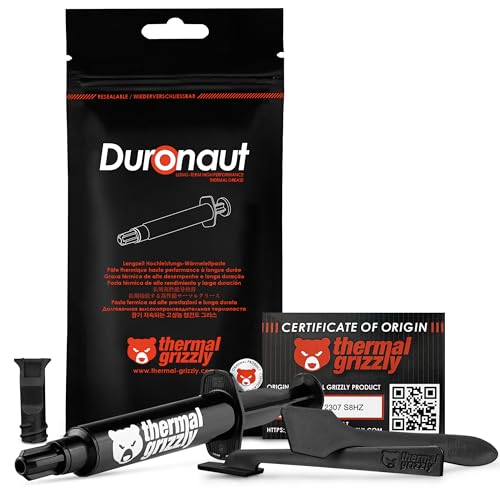
Premium Pick
Thermal Grizzly Duronaut (6g)
The highest-priced pick here at the time of writing, with a formula built to minimise pump-out.
Best for: Buyers who want the most complete package.
Our take Check price for Thermal Grizzly Duronaut (6g) (opens in a new tab)

Zinc Oxide Compound
Corsair XTM50 (5g)
A zinc oxide compound.
Best for: Buyers who want a zinc oxide compound.
Our take Check price for Corsair XTM50 (5g) (opens in a new tab)

Lowest Price Here
ARCTIC MX-7 (4g)
A lower price than the MX-6 8g and the rest when we checked.
Best for: Buyers who would rather put the savings elsewhere in the build.
Our take Check price for ARCTIC MX-7 (4g) (opens in a new tab)
| Pick | Why it’s here | Best for | Price |
|---|---|---|---|
| Lower thermal resistance than ARCTIC's MX-4, by the maker's measure. | Buyers who want lower thermal resistance than ARCTIC's MX-4, by the maker's measure. | Check price for ARCTIC MX-6 (8g) (opens in a new tab) |
| A dense, high-filler formula. | Buyers who want dense, high-filler formula. | Check price for ARCTIC MX-7 (8g) (opens in a new tab) |
| The highest-priced pick here at the time of writing, with a formula built to minimise pump-out. | Buyers who want the most complete package. | Check price for Thermal Grizzly Duronaut (6g) (opens in a new tab) |
| A zinc oxide compound. | Buyers who want a zinc oxide compound. | Check price for Corsair XTM50 (5g) (opens in a new tab) |
| A lower price than the MX-6 8g and the rest when we checked. | Buyers who would rather put the savings elsewhere in the build. | Check price for ARCTIC MX-7 (4g) (opens in a new tab) |
Our Picks
Also Consider1 of 5
ARCTIC MX-6 (8g) on Amazon (opens in a new tab)
MX-6 improves on MX-4's thermal resistance by ARCTIC's own measure and is thin enough for direct-die GPU and console chips.
Best for
- Buyers who want lower thermal resistance than ARCTIC's MX-4, by the maker's measure.
Skip if
- Price-first buyers should look at the MX-7, which cost less when we checked.
Why we like it
The 8g tube is the value size for anyone who repastes more than one machine. Its viscosity also suits direct-die work on graphics cards and consoles, where a thin layer matters. It is neither electrically conductive nor capacitive, so a little overflow onto nearby parts does no harm.
Clean off old paste with isopropyl alcohol first, then apply a pea-sized dot or a thin line on the heatspreader; on large Intel chips an X or a line covers the longer die better. Another plus is electrically non-conductive, so spills are harmless. When we checked, only the MX-7 cost less, and the MX-7 8g cost more.
Key dimensions & specs
- Amount: 8g
- Electrically non-conductive: Yes
Pros
- 8g is enough for several applications
- Electrically non-conductive, so spills are harmless
- Lower thermal resistance than ARCTIC's MX-4, by the maker's measure
- Viscosity suited to direct-die GPU and console chips
Cons
- Costs more than the MX-7 at the time of writing
Strong Alternative2 of 5
ARCTIC MX-7 (8g) on Amazon (opens in a new tab)
MX-7 is ARCTIC's densest paste, built to resist pump-out, drying and bleeding across repeated heat cycles.
Best for
- Buyers who want dense, high-filler formula.
Skip if
- Price-first buyers should look at the MX-7, which cost less when we checked.
Why we like it
It is designed to be pressed out by the cooler rather than spread, and the 8g tube lasts for many builds. It matches the MX-6 8g on tube size (8g). You also get a dense, high-filler formula.
Clean off old paste with isopropyl alcohol first, then apply a pea-sized dot or a thin line on the heatspreader; on large Intel chips an X or a line covers the longer die better. Do not pre-spread it; let the cooler's mounting pressure distribute it. On price it sat third of 5, between the cheaper MX-6 8g and the pricier XTM50, at the time of writing.
Key dimensions & specs
- Amount: 8g
- Electrically non-conductive: Yes
- Application: Cannot be spread by hand; cooler pressure distributes it
Pros
- 8g is enough for several applications
- Electrically non-conductive, so spills are harmless
- Dense, high-filler formula
- Resistance to pump-out, dry-out and bleeding over repeated heat cycles
Cons
- Costs more than the MX-7 at the time of writing
Premium Pick3 of 5
Thermal Grizzly Duronaut (6g) on Amazon (opens in a new tab)
Duronaut is Thermal Grizzly's durability-focused paste, using aluminium and zinc oxide particles to minimise pump-out.
Best for
- Buyers who want the most complete package.
Skip if
- Price-first buyers should look at the MX-7, which cost less when we checked.
Why we like it
The 6g tube comes with a TG Spatula Pro and suits hot CPUs you do not want to remount often. Its 6g tube size ranks third of 5 here, behind the MX-6 8g (8g) and ahead of the MX-7 (4g). It also offers a paste that does not harden over time.
Clean off old paste with isopropyl alcohol first, then apply a pea-sized dot or a thin line on the heatspreader; on large Intel chips an X or a line covers the longer die better. It was the most expensive pick when we checked, so weigh what it adds over the XTM50.
Key dimensions & specs
- Amount: 6g
- Compound: Aluminium and zinc oxide particles
- Electrically non-conductive: Yes
- In the box: a TG Spatula Pro
Pros
- 6g is enough for several applications
- Aluminium and zinc oxide particles formula
- Electrically non-conductive, so spills are harmless
- Includes a TG Spatula Pro
Cons
- Costs more than the MX-7 at the time of writing
Zinc Oxide Compound4 of 5
Corsair XTM50 (5g) on Amazon (opens in a new tab)
XTM50 is a zinc-oxide, non-conductive paste with a stencil and spreader in the box, which takes the guesswork out of coverage.
Best for
- Buyers who want a zinc oxide compound.
Skip if
- Skip it if price comes first: the MX-7 cost less when we checked.
Why we like it
Its low viscosity fills fine surface channels, and Corsair says it contains no volatile compounds. Its 5g tube size ranks fourth of 5 here, behind the MX-6 8g (8g) and ahead of the MX-7 (4g). It also comes with zero volatile compounds, by the maker's claim.
Clean off old paste with isopropyl alcohol first, then apply a pea-sized dot or a thin line on the heatspreader; on large Intel chips an X or a line covers the longer die better. On price it sat fourth of 5, between the cheaper MX-7 8g and the pricier Duronaut 6g, at the time of writing.
Key dimensions & specs
- Amount: 5g
- Compound: Zinc oxide
- Electrically non-conductive: Yes
- In the box: an application stencil and spreader
Pros
- 5g is enough for several applications
- Electrically non-conductive, so spills are harmless
- Includes an application stencil and spreader
- Low-viscosity compound that fills fine surface channels
Cons
- Costs more than the MX-7 at the time of writing
Lowest Price Here5 of 5
ARCTIC MX-7 (4g) on Amazon (opens in a new tab)
MX-7 is Arctic's dense, high-filler paste, built to resist pump-out and drying on hot CPUs.
Best for
- Buyers who would rather put the savings elsewhere in the build.
Skip if
- Skip it if tube size matters most to you; the MX-6 8g offers 8g.
Why we like it
It cannot be spread by hand, so apply a dot and let the cooler's pressure do the work. Its 4g tube size is the smallest in this group; the MX-6 8g leads at 8g. Clean off old paste with isopropyl alcohol first, then apply a pea-sized dot or a thin line on the heatspreader; on large Intel chips an X or a line covers the longer die better.
Do not pre-spread it; let the cooler's mounting pressure distribute it. Worth noting too: 4g is enough for several applications. It undercut the MX-6 8g and every other pick on price at the time of writing.
Key dimensions & specs
- Amount: 4g
- Electrically non-conductive: Yes
- Application: Cannot be spread by hand; cooler pressure distributes it
Pros
- 4g is enough for several applications
- Electrically non-conductive, so spills are harmless
- Dense, high-filler formula
- Resistance to pump-out, dry-out and bleeding
Cons
- Tube size trails the MX-6 8g (8g)
How We Chose
Each pick was assessed across 4 criteria weighted for real-world use.
- Safety
- We checked that each paste is listed as electrically non-conductive.
- Durability
- We looked for maker claims on pump-out and long-term stability.
- Value
- We compared tube sizes and what comes in the box.
- Application
- We noted spreaders, wipes and the maker's application guidance.
What to Look for in a Non-Conductive Thermal Paste
Key buying criteria so you get the right fit the first time.
Differences between good pastes are small
Among reputable pastes, temperatures usually differ by a few degrees at most. Mounting pressure and application matter as much as the paste.
Choose non-conductive paste
Non-conductive pastes are safe if a little spills onto nearby parts. Avoid liquid metal unless you know the risks.
Thicker pastes are harder to spread
High-performance pastes are often thick. Warming the tube in your hand makes them easier to apply.
Syringes are easier to control
A syringe tip lets you place a precise dot and reseal the rest. Tubs and wide nozzles tend to waste paste.
Treat W/mK figures with care
Makers measure conductivity under their own conditions, so a higher W/mK number on the box does not always mean lower temperatures in a PC. Compare pastes from the same test source instead.
Buy the amount you will use
One large CPU uses about 0.2g to 0.5g. A 1g tube covers a couple of builds; 4g or more suits regular remounts or several machines.
How to Choose a Non-Conductive Thermal Paste
By priority
| Priority | Consider | Why |
|---|---|---|
| Buyers who want lower thermal resistance than ARCTIC's MX-4, by the maker's measure | MX-6 8g | Lower thermal resistance than ARCTIC's MX-4, by the maker's measure |
| Buyers who want dense, high-filler formula | MX-7 8g | A dense, high-filler formula |
| Buyers who want the most complete package | Duronaut 6g | The highest-priced pick here at the time of writing, with a formula built to minimise pump-out |
| Buyers who want a zinc oxide compound | XTM50 | A zinc oxide compound |
| Buyers who would rather put the savings elsewhere in the build | MX-7 | A lower price than the MX-6 8g and the rest when we checked |
Scroll sideways to see every column.
Key specs side by side
Figures as each maker states them.
| Paste | Amount | Compound | Electrically non-conductive | In the box |
|---|---|---|---|---|
| MX-6 8g | 8g | Not listed | Yes | Not listed |
| MX-7 8g | 8g | Not listed | Yes | Not listed |
| Duronaut 6g | 6g | Aluminium and zinc oxide particles | Yes | a TG Spatula Pro |
| XTM50 | 5g | Zinc oxide | Yes | an application stencil and spreader |
| MX-7 | 4g | Not listed | Yes | Not listed |
Scroll sideways to see every column.
Frequently Asked Questions
How do these thermal pastes compare on tube size?
The MX-6 8g leads at 8g, ahead of the MX-7 8g at 8g; the MX-7 sits at the other end with 4g.
Which is the cheapest pick in this guide?
Start with the MX-7, the lowest-priced pick when we checked. The Duronaut 6g is the premium end, so the spread between them shows what extra money buys here.
Is a higher W/mK rating always better?
Not reliably. Makers test conductivity differently, so the figures are not directly comparable between brands.
Does thermal paste expire in the tube?
It can separate or thicken after a few years in storage. Noctua, for example, recommends using its paste within three years of purchase.
How often should I replace thermal paste?
Only when you remove the cooler or temperatures rise over time. Many pastes last several years on a desktop CPU.
Bottom Line
Our first pick is the MX-6 8g, chosen for lower thermal resistance than ARCTIC's MX-4, by the maker's measure. Look at the MX-7 8g for a dense, high-filler formula, the Duronaut 6g for the highest-priced pick here at the time of writing, with a formula built to minimise pump-out and the XTM50 for a zinc oxide compound if those matter more to you.
Still wipe away any overflow; non-conductive paste can hold dust.