
Buying Guide
The Best USB Microphones
USB mics now include hybrids with XLR outputs and onboard processing. These six cover streaming, podcasting and calls.
By The PC Journal editorial team
12 min read6 products evaluated
A USB mic needs no interface, and the best now include processing that used to need software. Two picks here also have XLR outputs for a later upgrade.
We compared capsule, patterns, mute, monitoring and processing from each listing.
Quick Picks
Our 6 recommendations at a glance. Tap a pick for the full verdict.

Best for Voice
Shure MV7+ Podcast Microphone
Dynamic with USB-C, XLR, auto level and denoiser.
Best for: Podcasts and streams
Our take Check price for Shure MV7+ Podcast Microphone (opens in a new tab)

Best Anti-Clipping
Elgato Wave:3 MK.2 USB Microphone
Clipguard 2.0 with auto gain.
Best for: Loud reactions
Our take Check price for Elgato Wave:3 MK.2 USB Microphone (opens in a new tab)

Most Patterns
Logitech G Blue Yeti USB Microphone
Four polar patterns from three capsules.
Best for: Interviews and groups
Our take Check price for Logitech G Blue Yeti USB Microphone (opens in a new tab)
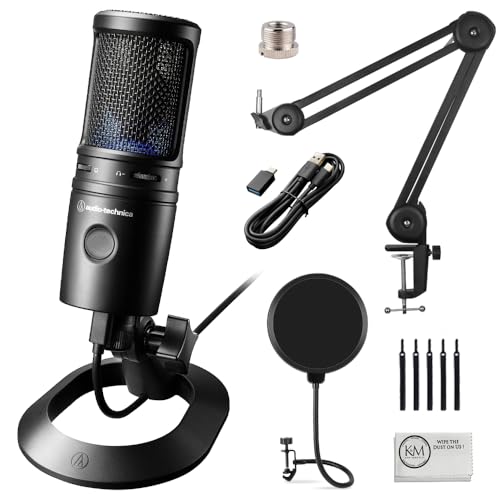
Best Bundle
Audio-Technica AT2020USB-X with Boom Arm
24-bit/96kHz with a boom arm included.
Best for: A complete setup
Our take Check price for Audio-Technica AT2020USB-X with Boom Arm (opens in a new tab)

Best RODE Hybrid
RODE PodMic USB
USB-C and XLR with APHEX processing.
Best for: Broadcast voice
Our take Check price for RODE PodMic USB (opens in a new tab)

Best RGB Mic
HyperX QuadCast 2 S USB Microphone
100+ addressable RGB LEDs.
Best for: On-camera setups
Our take Check price for HyperX QuadCast 2 S USB Microphone (opens in a new tab)
Our Picks
Best for Voice1 of 6
Shure MV7+ Podcast Microphone on Amazon (opens in a new tab)
Shure's MV7+ is a dynamic mic with USB-C and XLR outputs, an LED touch panel, auto level and a denoiser.
Best for
- Podcasts and streams
Skip if
- If budget leads, the Blue Yeti was cheaper at our last price check.
Why we like it
It suits a later move to an interface. It shares a USB-C and XLR connection with the PodMic USB; the Blue Yeti goes with a USB connection. Like the PodMic USB, it has a dynamic capsule, while the AT2020USB-X uses a condenser capsule.
No other pick in this guide offers a touch panel mute mute control; compare the AT2020USB-X, which has a capacitive touch mute mute control. It works over USB now and can move to an XLR interface later; an XLR cable may not be included. Only the PodMic USB came close to it on price at the time of writing; it cost the most of the 6 picks.
Key dimensions & specs
- Connection: USB-C and XLR
- Capsule: Dynamic
- Polar pattern: Cardioid
- Mute control: Touch panel mute
- Headphone monitoring: Headphone jack
- In the box: Yoke
Pros
- LED touch panel
- Auto level and a digital denoiser
- Both USB-C and XLR outputs
- Touch panel mute mute control, the only one here
Cons
- Costs more than the Blue Yeti at the time of writing
Best Anti-Clipping2 of 6
Elgato Wave:3 MK.2 USB Microphone on Amazon (opens in a new tab)
Elgato's Wave:3 MK.2 uses Clipguard 2.0 to prevent clipping and adds automatic gain.
Best for
- Loud reactions
Skip if
- Price-first buyers should look at the Blue Yeti, which cost less when we checked.
Why we like it
It connects over USB-C. Like the AT2020USB-X, it has a USB-C connection, while the PodMic USB uses a USB-C and XLR connection. It shares a condenser capsule with the AT2020USB-X and QuadCast 2 S; the PodMic USB goes with a dynamic capsule.
A capacitive mute mute control is unique to it among these picks, while the Blue Yeti uses a mute button mute control. It also comes with Clipguard 2.0 anti-distortion and onboard DSP. It plugs straight into a USB port and needs no interface. On price it sat second of 6, between the cheaper Blue Yeti and the pricier QuadCast 2 S, at the time of writing.
Key dimensions & specs
- Connection: USB-C
- Capsule: Condenser
- Polar pattern: Cardioid
- Mute control: Capacitive mute
- Headphone monitoring: Headphone jack
- In the box: Desk stand
Pros
- Clipguard 2.0 anti-distortion
- Automatic gain
- Onboard DSP
- Capacitive mute mute control, the only one here
Cons
- Costs more than the Blue Yeti at the time of writing
Most Patterns3 of 6
Logitech G Blue Yeti USB Microphone on Amazon (opens in a new tab)
Blue's Yeti uses three capsules to offer four polar patterns, with onboard gain and mute.
Best for
- Interviews and groups
Skip if
- Look at the other picks if you need a feature not covered above.
Why we like it
Blue VO!CE processing runs in G HUB. Its three-capsule array supports cardioid, omni, bidirectional and stereo patterns, and zero-latency monitoring runs through its headphone jack. It shares a USB connection with the QuadCast 2 S; the PodMic USB goes with a USB-C and XLR connection.
It is the only pick here with a condenser (three capsules); the QuadCast 2 S has a condenser capsule instead. It is the only pick here with a mute button mute control; the MV7+ has a touch panel mute mute control instead. It plugs straight into a USB port and needs no interface. No other pick here cost less at our last price check, and the Wave:3 MK.2 was closest.
Key dimensions & specs
- Connection: USB
- Capsule: Condenser (three capsules)
- Polar pattern: Cardioid, omni, bidirectional, stereo
- Mute control: Mute button
- Headphone monitoring: Headphone jack
- In the box: Desk stand
Pros
- Four polar patterns
- Onboard gain and mute controls
- Blue VO!CE processing in G HUB
- Condenser (three capsules), the only one here
Best Bundle4 of 6
Audio-Technica AT2020USB-X with Boom Arm on Amazon (opens in a new tab)
Audio-Technica's AT2020USB-X bundle records at 24-bit/96kHz and includes a boom arm.
Best for
- A complete setup
Skip if
- Price-first buyers should look at the Blue Yeti, which cost less when we checked.
Why we like it
Mute is a capacitive touch pad. Like the Wave:3 MK.2, it has a USB-C connection, while the MV7+ uses a USB-C and XLR connection. It shares a condenser capsule with the Wave:3 MK.2 and QuadCast 2 S; the PodMic USB goes with a dynamic capsule.
You get a capacitive touch mute mute control here, which sets it apart from the QuadCast 2 S and its a tap-to-mute mute control. It plugs straight into a USB port and needs no interface. Worth noting too: Boom arm in the box, the only one here. Its price falls between the QuadCast 2 S and the PodMic USB, based on our last check.
Key dimensions & specs
- Connection: USB-C
- Capsule: Condenser
- Polar pattern: Cardioid
- Mute control: Capacitive touch mute
- Headphone monitoring: Headphone jack
- In the box: Boom arm
Pros
- 24-bit/96kHz recording
- Capacitive touch mute
- Boom arm in the bundle
- 24-bit/96kHz with a boom arm included
Cons
- Costs more than the Blue Yeti at the time of writing
Best RODE Hybrid5 of 6
RODE PodMic USB on Amazon (opens in a new tab)
RODE's PodMic USB is a dynamic broadcast mic with both USB-C and XLR outputs and APHEX processing onboard.
Best for
- Broadcast voice
Skip if
- Pass on it if no onboard mut rules it out for your setup.
Why we like it
A headphone jack handles monitoring. It has both XLR and USB-C outputs, so it can move from a laptop to an interface later. Over USB, onboard APHEX processing adds compression, and zero-latency monitoring runs through its headphone jack.
Like the MV7+, it has a USB-C and XLR connection, while the Wave:3 MK.2 uses a USB-C connection. It shares a dynamic capsule with the MV7+; the Blue Yeti goes with a condenser (three capsules). You get a swing mount in the box here, which sets it apart from the MV7+ and its a yoke in the box.
It works over USB now and can move to an XLR interface later; an XLR cable may not be included. Its price falls between the AT2020USB-X and the MV7+, based on our last check.
Key dimensions & specs
- Connection: USB-C and XLR
- Capsule: Dynamic
- Polar pattern: Cardioid
- Mute control: None
- Headphone monitoring: Headphone jack
- In the box: Swing mount
Pros
- APHEX processing onboard
- Both USB-C and XLR outputs
- Headphone jack
- Swing mount in the box, the only one here
Cons
- no onboard mute
- Costs more than the Blue Yeti at the time of writing
Best RGB Mic6 of 6
HyperX QuadCast 2 S USB Microphone on Amazon (opens in a new tab)
HyperX's QuadCast 2 S adds more than 100 addressable RGB LEDs and a multifunction knob to the QuadCast 2.
Best for
- On-camera setups
Skip if
- Skip it if price comes first: the Blue Yeti cost less when we checked.
Why we like it
It offers four polar patterns. Over 100 addressable RGB LEDs can match stream colours, and a tap-to-mute sensor sits on top. It connects over USB.
Like the Blue Yeti, it has a USB connection, while the AT2020USB-X uses a USB-C connection. It shares a condenser capsule with the Wave:3 MK.2 and AT2020USB-X; the MV7+ goes with a dynamic capsule. No other pick in this guide offers a multi-pattern (4); compare the AT2020USB-X, which has a cardioid polar pattern.
It plugs straight into a USB port and needs no interface. On price it sat third of 6, between the cheaper Wave:3 MK.2 and the pricier AT2020USB-X, at the time of writing.
Key dimensions & specs
- Connection: USB
- Capsule: Condenser
- Polar pattern: Multi-pattern (4)
- Mute control: Tap-to-mute
- Headphone monitoring: Headphone jack
- In the box: Stand with shock mount
Pros
- More than 100 addressable RGB LEDs
- Four polar patterns
- Multifunction knob
- Multi-pattern (4), the only one here
Cons
- Costs more than the Blue Yeti at the time of writing
How We Chose These USB Microphones
Each pick was assessed across 4 criteria weighted for real-world use.
- Controls
- We checked mute, gain and headphone monitoring.
- Connection
- We recorded USB, XLR or hybrid connections.
- Capsule and pattern
- We noted dynamic or condenser capsules and polar patterns.
- Mounting
- We noted stands, arms, shock mounts and pop filters in the box.
What to Look for in a USB Microphone
Key buying criteria so you get the right fit the first time.
USB or XLR
USB mics plug straight into the PC. XLR mics need an interface but let you upgrade parts separately. Hybrid mics offer both.
Software and processing
Some mics offer noise reduction, auto gain or limiters in software. Check it runs on your operating system.
Polar pattern
Cardioid rejects sound from behind and suits one voice. Multi-pattern mics add omni or figure-8 for groups or interviews.
Mute and monitoring
Tap-to-mute and a headphone jack for zero-latency monitoring matter on streams and calls.
Dynamic or condenser
Dynamic mics pick up less room noise and keyboard clatter, which suits untreated rooms. Condensers capture more detail and more of the room.
Stand, arm and shock mount
A desk stand picks up bumps. A boom arm and shock mount put the mic closer to your mouth and away from the keyboard.
How to Choose a USB Microphone
By priority
| Priority | Consider | Why |
|---|---|---|
| Podcasts and streams | MV7+ | Dynamic with USB-C, XLR, auto level and denoiser |
| Loud reactions | Wave:3 MK.2 | Clipguard 2.0 with auto gain |
| Interviews and groups | Blue Yeti | Four polar patterns from three capsules |
| A complete setup | AT2020USB-X | 24-bit/96kHz with a boom arm included |
| Broadcast voice | PodMic USB | USB-C and XLR with APHEX processing |
| On-camera setups | QuadCast 2 S | 100+ addressable RGB LEDs |
Scroll sideways to see every column.
Key specs side by side
Figures as each maker states them.
| Microphone | Connection | Capsule | Polar pattern | Mute control |
|---|---|---|---|---|
| MV7+ | USB-C and XLR | Dynamic | Cardioid | Touch panel mute |
| Wave:3 MK.2 | USB-C | Condenser | Cardioid | Capacitive mute |
| Blue Yeti | USB | Condenser (three capsules) | Cardioid, omni, bidirectional, stereo | Mute button |
| AT2020USB-X | USB-C | Condenser | Cardioid | Capacitive touch mute |
| PodMic USB | USB-C and XLR | Dynamic | Cardioid | None |
| QuadCast 2 S | USB | Condenser | Multi-pattern (4) | Tap-to-mute |
Scroll sideways to see every column.
By price at the time of writing
Prices change often; these tiers reflect Amazon prices when this guide was updated.
| Price tier | Microphones |
|---|---|
| About $100 to $150 | Blue Yeti, Wave:3 MK.2, QuadCast 2 S |
| About $150 to $250 | AT2020USB-X, PodMic USB |
| About $250 to $500 | MV7+ |
Frequently Asked Questions
How do I reduce keyboard noise?
Use a dynamic or cardioid mic, position it close to your mouth and pointed away from the keyboard, and consider a boom arm.
What interface do I need for XLR?
Any USB audio interface with an XLR input and enough gain. Condensers also need 48V phantom power.
Do USB mics work on consoles?
Some do; check the product page for PS4, PS5 or Xbox support.
How far should I sit from the mic?
About a hand's width to 15cm for most voice mics; dynamic mics often want to be closer.
Is a separate mic better than a headset mic?
Usually, yes: a desk mic has a larger capsule and sits in a fixed position. Placement still matters more than price.
Do I need a pop filter?
It helps with plosive sounds such as P and B. Many mics include a foam cover or internal filter.
Bottom Line
The Shure MV7+ is the best USB mic for voice with USB-C, XLR and onboard processing. The Wave:3 MK.2 prevents clipping, the Yeti offers four patterns, the AT2020USB-X bundle includes an arm, the PodMic USB is the RODE hybrid, and the QuadCast 2 S is the lit option.