
Buying Guide
The Best 32-Inch Curved Gaming Monitors
From the 32GS60QC to the MPG 321CURX: three monitors ranked on refresh rate and screen size, with who should skip each one.
By Alex Morgan, PC Hardware Editor
11 min read3 products evaluated
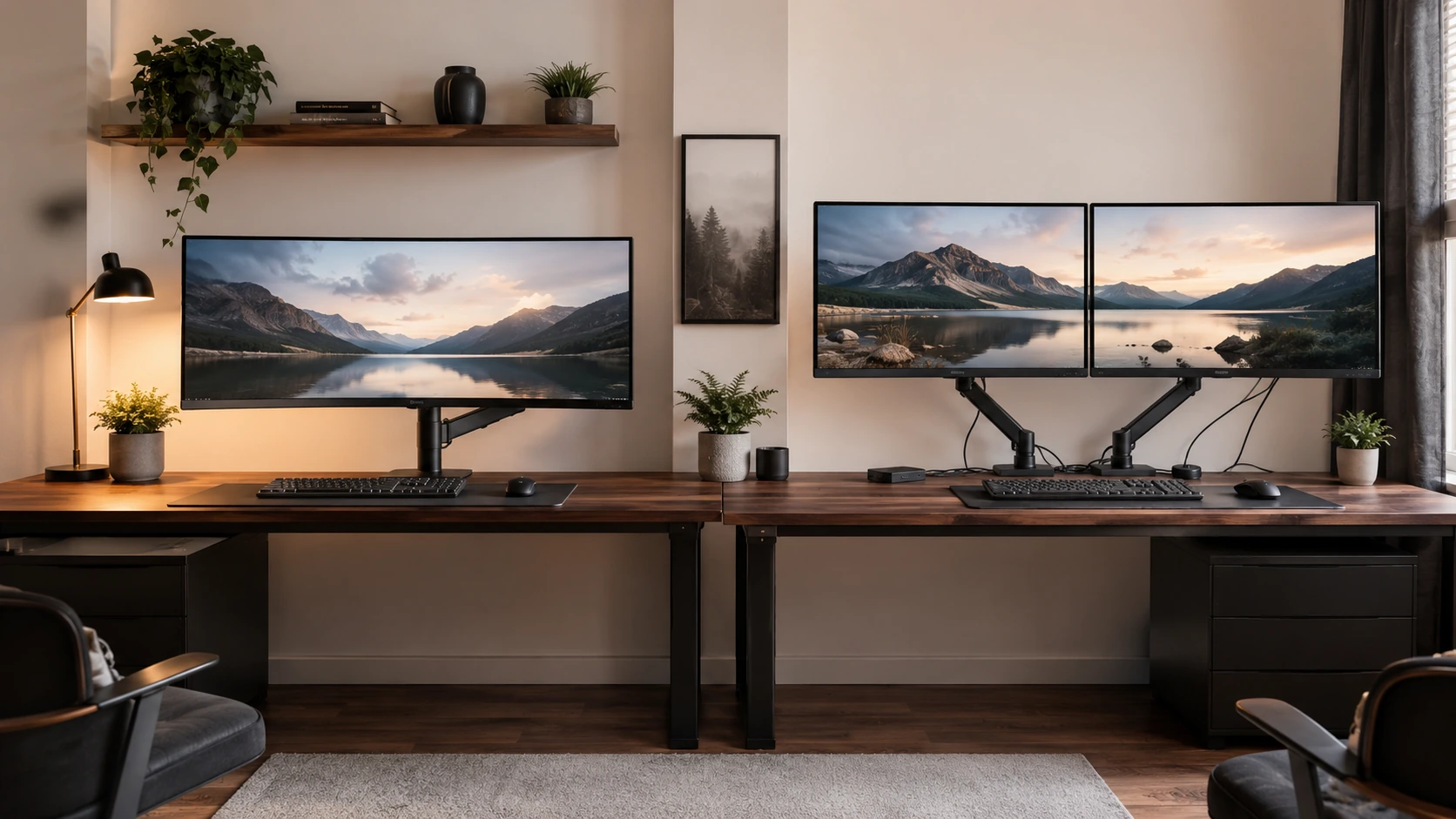
32-inch screens fit a standard desk depth, but resolution changes how close you can sit. Every monitor here measures about 32 inches, is curved and refreshes at 120Hz or more, ordered by refresh rate.
Our comparison rests on published figures for refresh rate, resolution and size; nothing here was tested in-house, and where a maker leaves out HDR, we say so.
Quick Picks
Which of the 3 picks to look at first. Tap a name for the full analysis.
Fastest Refresh
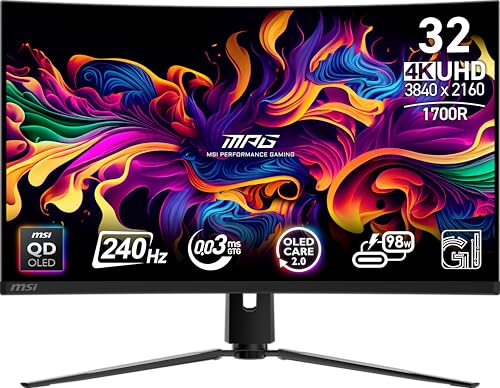
MSI MPG 321CURX QD-OLEDThe highest refresh rate here (240Hz).
Best for: Competitive shooters where motion clarity matters most.
Check price for MSI MPG 321CURX QD-OLED on Amazon (opens in a new tab)
Lowest Price Here
LG UltraGear 32GS60QC-BThe cheapest way into this group, below the Odyssey Neo G7.
Best for: Getting 1000R curved screen for the least money.
Check price for LG UltraGear 32GS60QC-B on Amazon (opens in a new tab)
Also Consider
Samsung Odyssey Neo G7 32-inchA Mini LED backlight Samsung calls Quantum Matrix.
Best for: Buyers who want Mini LED backlight Samsung calls Quantum Matrix.
Check price for Samsung Odyssey Neo G7 32-inch on Amazon (opens in a new tab)
| Pick | Why it stands out | Best for | Check price |
|---|---|---|---|
| The highest refresh rate here (240Hz). | Competitive shooters where motion clarity matters most. | Check price for MSI MPG 321CURX QD-OLED on Amazon (opens in a new tab) |
| The cheapest way into this group, below the Odyssey Neo G7. | Getting 1000R curved screen for the least money. | Check price for LG UltraGear 32GS60QC-B on Amazon (opens in a new tab) |
| A Mini LED backlight Samsung calls Quantum Matrix. | Buyers who want Mini LED backlight Samsung calls Quantum Matrix. | Check price for Samsung Odyssey Neo G7 32-inch on Amazon (opens in a new tab) |
Our Picks
Fastest Refresh1 of 3
MSI MPG 321CURX QD-OLED
The MPG 321CURX stands out for a 1700R curve, and it adds a 98W USB-C port and KVM switch.
Best for
- Competitive shooters where motion clarity matters most.
Skip if
- Choose another pick if you can't accept this: oLED burn-in risk with static desktop elements.
Why we like it
It also offers a 240Hz refresh rate and offers a 32 inches screen size. Nothing else here matches its 240Hz refresh rate; the 32GS60QC comes closest at 180Hz. Like the Odyssey Neo G7, it has a 3840x2160 (4K) resolution, while the 32GS60QC uses a 2560x1440 (1440p) resolution.
A G-SYNC Compatible is unique to it among these picks, while the 32GS60QC uses a FreeSync. Reaching 240Hz at 4K needs DisplayPort 1.4 with DSC or HDMI 2.1 on your graphics card, and a GPU able to render well above 100fps at 4K. Leave the maker's pixel-refresh routines enabled and hide static taskbars to limit burn-in risk.
G-SYNC Compatible works on NVIDIA cards over DisplayPort, and FreeSync covers AMD cards. It was the most expensive pick when we checked, so weigh what it adds over the Odyssey Neo G7.
Key specs
- Refresh rate
- 240Hz
- Resolution
- 3840x2160 (4K)
- Size
- 32 inches
- Panel
- QD-OLED
- Response
- 0.03ms
- HDR
- DisplayHDR True Black 400
- Adaptive sync
- G-SYNC Compatible
- USB-C
- Yes
Pros
- a 240Hz refresh rate for fast motion
- 4K resolution for sharp text and detail
- a QD-OLED panel with per-pixel contrast
- DisplayHDR True Black 400 certification
Cons
- OLED burn-in risk with static desktop elements
- Costs more than the 32GS60QC at the time of writing
Lowest Price Here2 of 3
LG UltraGear 32GS60QC-B
LG's 32GS60QC is a 32-inch 1440p screen at 180Hz with a tight 1000R curve.
Best for
- Getting 1000R curved screen for the least money.
Skip if
- Worth skipping when hDR10 support without a DisplayHDR certification is a problem.
Why we like it
It costs a fraction of the 4K models and asks far less of the graphics card. Its 180Hz refresh rate ranks second of 3 here, behind the MPG 321CURX (240Hz) and ahead of the Odyssey Neo G7 (165Hz). No other pick in this guide offers a 2560x1440 (1440p) resolution; compare the MPG 321CURX, which has a 3840x2160 (4K) resolution.
You get a FreeSync here, which sets it apart from the MPG 321CURX and its a G-SYNC Compatible. It also comes with two HDMI inputs and one DisplayPort. It undercut the Odyssey Neo G7 and every other pick on price at the time of writing.
Key specs
- Refresh rate
- 180Hz
- Resolution
- 2560x1440 (1440p)
- Size
- 32 inches
- Response
- 1ms
- HDR
- HDR10
- Color gamut
- 99% sRGB
- Adaptive sync
- FreeSync
Pros
- 180Hz for smoother motion than a 60Hz office screen
- 1440p resolution, sharper than 1080p at 27 inches
- 99% sRGB colour coverage
- FreeSync to reduce screen tearing
Cons
- HDR10 support without a DisplayHDR certification
- Refresh rate of 180Hz, behind the MPG 321CURX (240Hz)
Also Consider3 of 3
Samsung Odyssey Neo G7 32-inch
Samsung's Odyssey Neo G7 uses a Mini LED backlight behind a 32-inch 4K screen at 165Hz.
Best for
- Buyers who want Mini LED backlight Samsung calls Quantum Matrix.
Skip if
- Skip it if refresh rate matters most to you; the MPG 321CURX offers 240Hz.
Why we like it
The 1000R curve is steep for a 16:9 monitor, and its Quantum HDR2000 label is Samsung's own rating rather than a VESA tier. It reaches 2,000 nits peak with Quantum HDR 2000, and CoreSync lighting on the back matches on-screen colours. The 1000R curve fills your view.
On refresh rate it trails the group at 165Hz, while the MPG 321CURX offers 240Hz. It shares a 3840x2160 (4K) resolution with the MPG 321CURX; the 32GS60QC goes with a 2560x1440 (1440p) resolution. Reaching 165Hz at 4K needs DisplayPort 1.4 with DSC or HDMI 2.1 on your graphics card, and a GPU able to render well above 100fps at 4K.
G-SYNC Compatible works on NVIDIA cards over DisplayPort, and FreeSync covers AMD cards. When we checked, only the 32GS60QC cost less, and the MPG 321CURX cost more.
Key specs
- Refresh rate
- 165Hz
- Resolution
- 3840x2160 (4K)
- Size
- 32 inches
- Response
- 1ms
- Adaptive sync
- G-SYNC Compatible, FreeSync Premium Pro
Pros
- 165Hz for smoother motion than a 60Hz office screen
- 4K resolution for sharp text and detail
- G-SYNC Compatible, FreeSync Premium Pro to reduce screen tearing
- Mini LED backlight Samsung calls Quantum Matrix
Cons
- Refresh rate trails the MPG 321CURX (240Hz)
- Costs more than the 32GS60QC at the time of writing
The catch
Refresh rate is its weakest area, and the MPG 321CURX covers it better at 240Hz.
How We Chose These 32-Inch Curved Gaming Monitors
Alex Morgan compared the manufacturer specifications, connectivity, warranty terms and compatibility of every pick. Figures come from the makers unless a third-party source is named; we did not test these products ourselves.
- What we compared
- We compared three monitors on refresh rate, resolution, screen size and response, using each maker's published specs. These are research figures, not bench results: 1 of 3 picks leave out HDR.
- The shared baseline
- All 3, from the MPG 321CURX to the Odyssey Neo G7, state refresh rate, resolution and screen size.
- Where the specs have gaps
- The Odyssey Neo G7 gives no HDR.
- Price range
- At our last check the picks ran from the 32GS60QC ($150 to $250) to the MPG 321CURX ($500 to $1000).
What to Look for in a 32-Inch Curved Gaming Monitor
Key buying criteria so you get the right fit the first time.
Refresh rate across these picks
Across these 3 picks refresh rate spans 165Hz (the Odyssey Neo G7) to 240Hz (the MPG 321CURX). For less, the 32GS60QC is the runner-up at 180Hz ($150 to $250 tier).
Response
The MPG 321CURX lists 0.03ms; the 32GS60QC and the Odyssey Neo G7 list 1ms. Sort out response before price: it splits 3 stated picks into groups of 2 and 1.
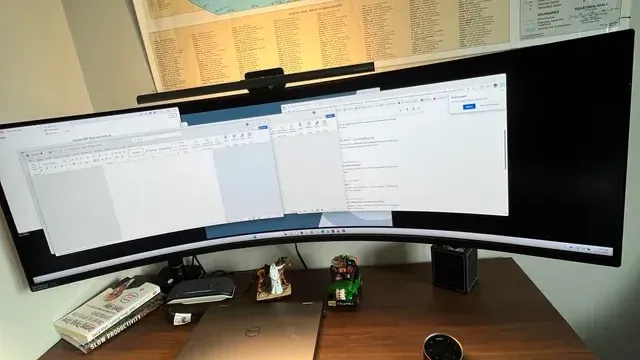
A curved ultrawide monitor showing documents HDR
The MPG 321CURX lists DisplayHDR True Black 400; the 32GS60QC lists HDR10.
Features beyond the spec table
The MPG 321CURX: a 98W USB-C port and KVM switch. The 32GS60QC: two HDMI inputs and one DisplayPort. The Odyssey Neo G7: a 1000R curved screen.
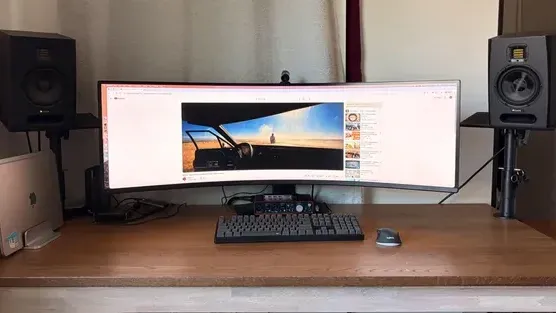
A super-ultrawide monitor between two speakers Budget
$150 to $250 buys the 32GS60QC; $500 to $1000 buys the Odyssey Neo G7 and the MPG 321CURX at our last check.
How to Choose a 32-Inch Curved Gaming Monitor
By priority
| Priority | Consider | Why |
|---|---|---|
| Competitive shooters where motion clarity matters most | MPG 321CURX | The highest refresh rate here (240Hz) |
| Getting 1000R curved screen for the least money | 32GS60QC | The cheapest way into this group, below the Odyssey Neo G7 |
| Buyers who want Mini LED backlight Samsung calls Quantum Matrix | Odyssey Neo G7 | A Mini LED backlight Samsung calls Quantum Matrix |
Scroll sideways to see every column.
Key specs side by side
The MPG 321CURX leads on refresh rate at 240Hz, ahead of the 32GS60QC at 180Hz.
| Monitor | Refresh rate | Resolution | Size | Response |
|---|---|---|---|---|
| MPG 321CURX | 240Hz | 3840x2160 (4K) | 32 inches | 0.03ms |
| 32GS60QC | 180Hz | 2560x1440 (1440p) | 32 inches | 1ms |
| Odyssey Neo G7 | 165Hz | 3840x2160 (4K) | 32 inches | 1ms |
Scroll sideways to see every column.
By price at the time of writing
At our last check the cheapest pick, the 32GS60QC, sat in the $150 to $250 tier, 2 tiers in all up to the MPG 321CURX at $500 to $1000; Amazon prices move, so recheck before buying.
| Price tier | Monitors |
|---|---|
| About $150 to $250 | 32GS60QC |
| About $500 to $1000 | Odyssey Neo G7, MPG 321CURX |
Frequently Asked Questions
Is the MPG 321CURX ahead of the 32GS60QC on refresh rate?
The MPG 321CURX tops refresh rate at 240Hz; the 32GS60QC follows at 180Hz, 33% apart. The spread runs down to the Odyssey Neo G7 at 165Hz.
Is the MPG 321CURX worth paying more than the 32GS60QC?
The spec sheets show refresh rate (240Hz against 180Hz) in its favour. The 32GS60QC sat in the $150 to $250 tier and the MPG 321CURX in the $500 to $1000 tier when we checked, with 1 other pick between them; pay the difference only if refresh rate decides your purchase.
What makes the MPG 321CURX the Fastest Refresh?
It earns the label for the highest refresh rate here (240Hz). The 32GS60QC is next on refresh rate at 180Hz, so this pick's 240Hz is 33% further out. The 32GS60QC, the cheapest pick, sat in the $150 to $250 tier against $500 to $1000 here, without out-ranking it on any listed spec. It makes sense for competitive shooters where motion clarity matters most.
Do the MPG 321CURX and the 32GS60QC differ on resolution?
The MPG 321CURX and the Odyssey Neo G7 use 3840x2160 (4K); the 32GS60QC uses 2560x1440 (1440p).
Beyond the specs, what sets the MPG 321CURX and the 32GS60QC apart?
The MPG 321CURX: a 1700R curve. The 32GS60QC: a 1000R curved screen. The Odyssey Neo G7: a Mini LED backlight Samsung calls Quantum Matrix.
Bottom Line
Our first pick is the MPG 321CURX. Look at the 32GS60QC for the cheapest way into this group, below the Odyssey Neo G7 and the Odyssey Neo G7 for a Mini LED backlight Samsung calls Quantum Matrix if those matter more to you.
Measure desk depth before buying a larger screen.
Related Guides
- Related guideThe Best Gaming Monitors to Buy Now
- Related guideThe Best 1440p Gaming Monitors to Buy
- Related guideThe Best OLED Gaming Monitors
- Similar guideThe Best 27-Inch Curved Gaming Monitors
- Similar guideThe Best 34-Inch Curved Gaming Monitors
- ExplainerHow to Choose an Ultrawide Monitor
- ExplainerUltrawide Monitor Resolutions: 2560x1080, 3440x1440, 3840x1600 and 5120x1440
- Also see: graphics cardsWhen Is Integrated Graphics Enough for a PC?
- Similar guideThe Best Curved Gaming Monitors
- Topic hubAll ultrawide and curved monitors guides
About the author
PC Hardware Editor
Alex covers PC hardware, monitors, components, upgrades and peripherals for The PC Journal, with a focus on helping readers understand specifications, compatibility and meaningful product trade-offs.
Covers: Monitors, Graphics cards, Processors, PC components, Peripherals, Upgrades and compatibility
View all articles