
Buying Guide
The Best 27-Inch 1440p Gaming Monitors
We compared six monitors on what your PC can actually drive: refresh rate, the input that carries it, OLED burn-in cover and text clarity.
By The PC Journal editorial team
11 min read6 products evaluated
A 27-inch 1440p monitor is the most common upgrade for a gaming PC, and the choice now splits between OLED panels with very high refresh rates and bright Mini LED LCDs. The right one depends less on the headline refresh rate than on what your graphics card can drive and how you use the desk.
We compared six monitors on refresh rate, the inputs that carry it, coating, burn-in cover and text clarity, using manufacturer specifications and TFTCentral's review findings. We did not test these monitors ourselves.
Two checks apply to every pick: the frame rate your graphics card reaches at 1440p in your games, and whether you will leave static windows on screen for hours. The first sets the refresh rate worth paying for; the second decides whether OLED suits you.
Quick Picks
Our 6 recommendations at a glance. Tap a pick for the full verdict.

Highest Refresh Rate
ASUS ROG Swift OLED PG27AQWP-W
540Hz Tandem WOLED with DisplayPort 2.1 and a 3-year burn-in warranty.
Best for: Competitive players whose graphics card sustains very high frame rates at 1440p.
Our take Check price for ASUS ROG Swift OLED PG27AQWP-W (opens in a new tab)

Best for PC and Console
MSI MAG 272QP QD-OLED X50
500Hz QD-OLED with two HDMI 2.1 inputs and USB-C.
Best for: A gaming PC that shares the monitor with a console or USB-C laptop.
Our take Check price for MSI MAG 272QP QD-OLED X50 (opens in a new tab)

Best OLED for Work and Play
Gigabyte MO27Q28G
280Hz Tandem WOLED with a matte coating, USB-C and KVM.
Best for: One monitor for work and gaming, especially in a bright room.
Our take Check price for Gigabyte MO27Q28G (opens in a new tab)

Best Lower-Cost OLED
MSI MAG 271QP QD-OLED X28
280Hz QD-OLED with the same inputs as the X50, for less.
Best for: Gamers who want OLED contrast without paying for 500Hz.
Our take Check price for MSI MAG 271QP QD-OLED X28 (opens in a new tab)

Best Budget OLED
LG UltraGear 27GS93QE
240Hz WOLED with an anti-glare coating and a 2-year panel warranty.
Best for: A first OLED on a tighter budget, for gaming more than text work.
Our take Check price for LG UltraGear 27GS93QE (opens in a new tab)
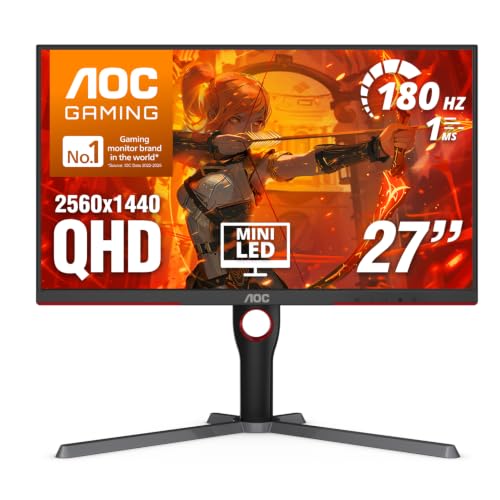
Best HDR Without Burn-In Risk
AOC Q27G3XMN
Mini LED LCD with 336 dimming zones and no burn-in risk.
Best for: Mixed desktop use with long static layouts, and HDR on a budget.
| Pick | Why it’s here | Best for | Price |
|---|---|---|---|
| 540Hz Tandem WOLED with DisplayPort 2.1 and a 3-year burn-in warranty. | Competitive players whose graphics card sustains very high frame rates at 1440p. | Check price for ASUS ROG Swift OLED PG27AQWP-W (opens in a new tab) |
| 500Hz QD-OLED with two HDMI 2.1 inputs and USB-C. | A gaming PC that shares the monitor with a console or USB-C laptop. | Check price for MSI MAG 272QP QD-OLED X50 (opens in a new tab) |
| 280Hz Tandem WOLED with a matte coating, USB-C and KVM. | One monitor for work and gaming, especially in a bright room. | Check price for Gigabyte MO27Q28G (opens in a new tab) |
| 280Hz QD-OLED with the same inputs as the X50, for less. | Gamers who want OLED contrast without paying for 500Hz. | Check price for MSI MAG 271QP QD-OLED X28 (opens in a new tab) |
| 240Hz WOLED with an anti-glare coating and a 2-year panel warranty. | A first OLED on a tighter budget, for gaming more than text work. | Check price for LG UltraGear 27GS93QE (opens in a new tab) |
| Mini LED LCD with 336 dimming zones and no burn-in risk. | Mixed desktop use with long static layouts, and HDR on a budget. | Check price for AOC Q27G3XMN (opens in a new tab) |
Our Picks
Highest Refresh Rate1 of 6
ASUS ROG Swift OLED PG27AQWP-W on Amazon (opens in a new tab)
The PG27AQWP-W is the pick for competitive players with a graphics card that can sustain very high frame rates: it runs 540Hz at 1440p, the fastest here, and TFTCentral names it its top 27-inch 1440p OLED.
Best for
- Competitive players whose graphics card sustains very high frame rates at 1440p.
Skip if
- You need USB-C docking or a KVM, or your games run well below 240 fps.
Why we like it
Its Tandem WOLED panel uses an updated sub-pixel layout that TFTCentral found improves text clarity over older WOLED panels, and ASUS includes a 3-year warranty with burn-in cover. A DisplayPort 2.1 UHBR20 input carries the full refresh rate.
It is a gaming-first display. TFTCentral notes it has no USB-C, KVM, speakers or picture-in-picture, and the 720Hz mode runs only at 1280 × 720. The glossy coating also reflects room light.
Key dimensions & specs
- Panel: 27in Tandem WOLED, glossy
- Refresh: 540Hz (720Hz at 720p)
- Inputs: DisplayPort 2.1 UHBR20, HDMI 2.1
- Warranty: 3 years incl. burn-in
Pros
- 540Hz at 1440p
- DisplayPort 2.1 input
- Burn-in cover for 3 years
- Improved WOLED text clarity
Cons
- No USB-C, KVM or speakers
- Glossy screen reflects light
- 720Hz mode only at 720p
Best for PC and Console2 of 6
MSI MAG 272QP QD-OLED X50 on Amazon (opens in a new tab)
The MAG 272QP X50 is the pick for a desk shared with a console or laptop: MSI lists DisplayPort 1.4a, two HDMI 2.1 ports and USB-C with 15W power delivery, all at 1440p and 500Hz.
Best for
- A gaming PC that shares the monitor with a console or USB-C laptop.
Skip if
- You read or code for hours and notice colored fringes on text.
Why we like it
Its QD-OLED panel reaches 500Hz, MSI's OLED Care 2.0 software helps prevent burn-in, and Club386 offers a 3-year burn-in warranty. Club386 notes that the maximum refresh rate relies on Display Stream Compression (DSC) on each input.
Club386 also lists text fringing and no USB hub among its downsides. If you read or code for hours, the WOLED picks render text more cleanly.
Key dimensions & specs
- Panel: 26.5in QD-OLED
- Refresh: 500Hz
- Inputs: DisplayPort 1.4a, 2× HDMI 2.1, USB-C (15W)
- Warranty: 3 years incl. burn-in
Pros
- 500Hz QD-OLED
- Two HDMI 2.1 inputs
- USB-C with DisplayPort
- Burn-in cover
Cons
- Text fringing noted by reviewers
- Full refresh needs DSC
- USB-C only 15W
Best OLED for Work and Play3 of 6
Gigabyte MO27Q28G on Amazon (opens in a new tab)
The MO27Q28G is the pick for one monitor that handles daytime work and evening games: TFTCentral names it its mid-tier 27-inch 1440p OLED, with a 280Hz Tandem WOLED panel and the office extras the faster models lack.
Best for
- One monitor for work and gaming, especially in a bright room.
Skip if
- You play competitively at frame rates above 280 fps.
Why we like it
PCWorld offers two HDMI 2.1 ports, DisplayPort 1.4, USB-C with 18W power delivery and a KVM switch, plus speakers. Gigabyte describes a matte anti-reflection coating and a 3-year warranty; a glossy version is sold as the MO27Q28GR.
280Hz is not as fast as the 500Hz and 540Hz picks, and PCWorld lists the 18W USB-C as a downside. Check Gigabyte's burn-in terms for your region before buying.
Key dimensions & specs
- Panel: 27in Tandem WOLED, matte
- Refresh: 280Hz
- Inputs: DisplayPort 1.4, 2× HDMI 2.1, USB-C (18W)
- Extras: KVM, speakers
Pros
- USB-C, KVM and speakers
- Matte coating for bright rooms
- Improved WOLED text clarity
Cons
- 280Hz ceiling
- USB-C only 18W
- Burn-in terms not verified
Best Lower-Cost OLED4 of 6
MSI MAG 271QP QD-OLED X28 on Amazon (opens in a new tab)
The MAG 271QP X28 is the pick for OLED contrast at a lower price: MSI offers a 280Hz QD-OLED panel with the same DisplayPort 1.4a, HDMI 2.1 and 15W USB-C inputs as the 500Hz X50.
Best for
- Gamers who want OLED contrast without paying for 500Hz.
Skip if
- Text clarity for long work sessions is a priority.
Why we like it
MSI's listing includes OLED Care 2.0 burn-in protection and a 4-way adjustable stand. At 280Hz it matches the Gigabyte's refresh rate, but it uses a QD-OLED panel rather than WOLED.
That panel type is the trade-off: expect the same text fringing reviewers note on the X50. The Gigabyte is the better lower-refresh OLED for text-heavy work.
Key dimensions & specs
- Panel: 26.5in QD-OLED
- Refresh: 280Hz
- Inputs: DisplayPort 1.4a, HDMI 2.1, USB-C (15W)
- Stand: tilt, swivel, height
Pros
- OLED at a lower price
- Same inputs as the X50
- USB-C with DisplayPort
Cons
- QD-OLED text fringing
- 280Hz ceiling
Best Budget OLED5 of 6
LG UltraGear 27GS93QE on Amazon (opens in a new tab)
The 27GS93QE is the pick for the lowest-cost OLED here: LG offers a 240Hz WOLED panel with an anti-glare, low-reflection coating and G-SYNC Compatible validation.
Best for
- A first OLED on a tighter budget, for gaming more than text work.
Skip if
- You want 3 years of burn-in cover or the sharper text of a Tandem WOLED.
Why we like it
LG's listing states a 2-year warranty that covers the OLED panel, plus HDMI 2.1 and DisplayPort 1.4 inputs that both run 240Hz. The stand adjusts for height, tilt and pivot. It is an older-generation WOLED panel, so it lacks the updated sub-pixel layout of the Tandem WOLED picks, and its warranty is a year shorter than the ASUS and MSI models.
Key dimensions & specs
- Panel: 27in WOLED, anti-glare
- Refresh: 240Hz
- Inputs: DisplayPort 1.4, HDMI 2.1
- Warranty: 2 years incl. panel
Pros
- Lowest-cost OLED here
- Anti-glare coating
- Height, tilt and pivot stand
Cons
- Shorter 2-year warranty
- Older WOLED sub-pixel layout
- No USB-C
Best HDR Without Burn-In Risk6 of 6
AOC Q27G3XMN on Amazon (opens in a new tab)
The Q27G3XMN is the pick for bright HDR without OLED's burn-in concern: it is a VA LCD with a 336-zone Mini LED backlight, and TFTCentral measured an HDR peak of 1365 nits.
Best for
- Mixed desktop use with long static layouts, and HDR on a budget.
Skip if
- You play fast competitive games or need USB-C.
Why we like it
TFTCentral also measured 3.29ms of display lag at 180Hz and found very low blooming for a monitor at this price. Static taskbars and game HUDs are not a concern on an LCD.
The limits are speed and connections. It tops out at 180Hz over DisplayPort and 144Hz over its HDMI 2.0 ports, and VA panels smear more in dark transitions than OLED; TFTCentral recommends the Medium overdrive setting with variable refresh.
Key dimensions & specs
- Panel: 27in VA, Mini LED (336 zones)
- Refresh: 180Hz (DisplayPort), 144Hz (HDMI 2.0)
- HDR peak: 1365 nits (TFTCentral)
- Display lag: 3.29ms at 180Hz (TFTCentral)
Pros
- No burn-in risk
- Very bright HDR
- Low display lag
- Lowest price here
Cons
- VA dark smearing
- HDMI 2.0 limits to 144Hz
- Few extra features
How We Chose These 1440p Gaming Monitors
Each pick was assessed across 4 criteria weighted for real-world use.
- Refresh and inputs
- We recorded the maximum refresh rate and which inputs carry it, since that decides what your PC or console can actually use.
- Panel and text
- We noted panel type and reviewer findings on text rendering, which matters if the monitor doubles as a work screen.
- Burn-in cover
- For OLEDs we checked warranty length and whether burn-in is covered, using manufacturer listings and reviews.
- Measured findings
- Where available we used TFTCentral's measurements for HDR brightness, display lag and motion, attributed in each pick.
What to Look for in a 1440p Gaming Monitor
Key buying criteria so you get the right fit the first time.
Refresh rate your GPU can use
A higher refresh rate only helps up to the frame rate your graphics card delivers at 1440p. Check benchmarks for your card in the games you play.
240Hz to 280Hz covers most players. 500Hz and above pays off in competitive games that already run at very high frame rates.
Which input carries full refresh
Monitors often reach their maximum refresh rate only on certain inputs. The AOC runs 180Hz on DisplayPort but 144Hz on HDMI 2.0.
Match the input to your graphics card's outputs and to any console you plan to connect.
DSC and bandwidth
At 1440p and 500Hz, DisplayPort 1.4 does not have enough bandwidth without Display Stream Compression. The MSI X50 relies on DSC to reach 500Hz.
DSC is designed to be visually lossless, but your graphics card must support it.
WOLED or QD-OLED for text
OLED sub-pixels are not arranged like an LCD's, which can add colored fringes around text. The newer Tandem WOLED panels here use an updated layout that improves this.
Reviewers still note fringing on the QD-OLED picks, so choose WOLED if the monitor is also your work screen.
Burn-in cover in writing
Burn-in is a usage risk rather than a defect, so the warranty terms matter. The ASUS and MSI X50 list 3 years including burn-in; the LG offers 2 years including the panel.
If your desk shows static windows for hours, check the terms for your region or choose the Mini LED AOC.
Glossy or matte
Glossy coatings look sharper and show deeper blacks but reflect lamps and windows. Matte and anti-glare coatings suit bright rooms.
The ASUS is glossy; the Gigabyte and LG use anti-glare coatings.
How to Choose a 1440p Gaming Monitor
By priority
| Priority | Consider | Why |
|---|---|---|
| Maximum competitive speed | ASUS ROG Swift OLED PG27AQWP-W | 540Hz with DisplayPort 2.1 |
| Sharing with a console or laptop | MSI MAG 272QP QD-OLED X50 | Two HDMI 2.1 inputs and USB-C |
| Work and gaming on one screen | Gigabyte MO27Q28G | Matte coating, USB-C, KVM, speakers |
| OLED for less | MSI MAG 271QP QD-OLED X28 | 280Hz QD-OLED with the X50's inputs |
| Lowest-cost OLED | LG UltraGear 27GS93QE | 240Hz WOLED with anti-glare coating |
| HDR with no burn-in worry | AOC Q27G3XMN | Mini LED LCD, 1365-nit HDR peak |
Scroll sideways to see every column.
By price at the time of writing
Prices change often; these tiers reflect Amazon prices when this guide was updated.
| Price tier | Monitors |
|---|---|
| About $290 | AOC Q27G3XMN |
| About $420 to $500 | Gigabyte MO27Q28G, MSI MAG 271QP X28, LG 27GS93QE |
| About $600 | MSI MAG 272QP X50 |
| About $1,100 | ASUS ROG Swift OLED PG27AQWP-W |
Frequently Asked Questions
Is 1440p the right resolution for a 27-inch monitor?
For most gaming PCs, yes. 1440p is sharper than 1080p at this size and much easier to drive at high refresh rates than 4K.
Do I need a 500Hz monitor?
Only if your graphics card sustains very high frame rates in competitive games. If your games run nearer 120 to 200 fps, a 240Hz or 280Hz model gives you almost the same experience.
Will an OLED monitor burn in?
It can with long periods of static content. Pixel-shift and OLED care features reduce the risk, and several picks here include burn-in in their warranty. The Mini LED AOC avoids the issue entirely.
Can I connect a PS5 or Xbox Series X?
Yes, through HDMI. The HDMI 2.1 picks give consoles the most headroom; the AOC's HDMI 2.0 ports top out at 144Hz.
Why does text look fringed on some OLEDs?
OLED sub-pixels use a different layout from LCDs, which Windows text rendering does not always match. Newer Tandem WOLED panels reduce the effect.
Does my graphics card need DisplayPort 2.1?
Only for the ASUS's full-bandwidth input. The other picks reach their maximum refresh over DisplayPort 1.4, some with DSC.
Bottom Line
Match the refresh rate to the frame rates your graphics card actually reaches. For most players the Gigabyte MO27Q28G is the best all-round OLED, with a matte coating and work features; the ASUS PG27AQWP-W is the fastest if you play competitively on a high-end card, and the MSI X50 suits a desk shared with a console.
On a budget, the LG 27GS93QE and MSI X28 bring OLED contrast for less. If burn-in worries you, the AOC Q27G3XMN delivers bright HDR on an LCD.