
Buying Guide
The Best Programmable Keyboards
Five keyboards compared, from the GK61 to the C1 Pro, with the trade-offs of each named.
By The PC Journal editorial team
12 min read5 products evaluated
Programmable keyboards let you remap keys and record macros. Every pick supports remapping or macros, ordered from the lowest price.
We sorted these picks by layout, switches and connection, working from the makers' own data; if a maker skips polling rate, the guide says so, and no figure here comes from our own testing.
Quick Picks
Our 5 recommendations at a glance. Tap a pick for the full verdict.

Lowest Price Here
Geeky GK61 60% Keyboard
Undercutting the K617 on price when we checked.
Best for: Buyers who would rather put the savings elsewhere in the build.
Our take Check price for Geeky GK61 60% Keyboard (opens in a new tab)
Also Consider
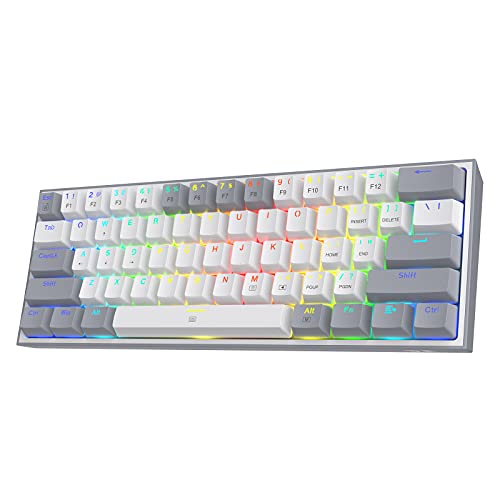
Redragon K617 Fizz 60% Keyboard
Hot-swap sockets for 3-pin and 5-pin switches.
Best for: Buyers who want hot-swap sockets for 3-pin and 5-pin switches.
Our take Check price for Redragon K617 Fizz 60% Keyboard (opens in a new tab)

Full-size Layout
Redragon K671 Mechanical Keyboard
A full-size layout.
Best for: Buyers who want a full-size layout.
Our take Check price for Redragon K671 Mechanical Keyboard (opens in a new tab)

Strong Alternative
Redragon K668 Wired Keyboard
4 extra hotkeys.
Best for: Buyers who want 4 extra hotkeys.
Our take Check price for Redragon K668 Wired Keyboard (opens in a new tab)

Premium Pick
Keychron C1 Pro Wired Mechanical Keyboard
QMK and VIA remapping support at the highest price in the group.
Best for: Buyers for whom price is not the deciding factor.
Our take Check price for Keychron C1 Pro Wired Mechanical Keyboard (opens in a new tab)
Our Picks
Lowest Price Here1 of 5
Geeky GK61 60% Keyboard on Amazon (opens in a new tab)
Geeky's GK61 is a hot-swappable 60% board with macro software and Mac support.
Best for
- Buyers who would rather put the savings elsewhere in the build.
Skip if
- Pass on it if no dedicated arrow keys or function ro rules it out for your setup.
Why we like it
It sits near $22 at the time of writing. Hot-swap sockets let you change switches without soldering, using the tools in the box. The detachable USB-C cable and 60% layout make it easy to pack for LAN events.
You get a 60% (61 keys) layout here, which sets it apart from the C1 Pro and its a TKL (80%) layout. The GK61 needs a free USB port, so check cable length to your case or monitor hub. Small layouts move keys to a function layer, so check the legend for arrows and F-keys. No other pick here cost less at our last price check, and the K617 was closest.
Key dimensions & specs
- Layout: 60% (61 keys)
- Switches: Mechanical, hot-swappable
- Connection: Wired
- Polling rate: 1,000Hz
Pros
- Compact 60% (61 keys) layout
- Mechanical, hot-swappable switches
- Hot-swap sockets
- Macro and remapping software
Cons
- No dedicated arrow keys or function row
- Wired only
Also Consider2 of 5
Redragon K617 Fizz 60% Keyboard on Amazon (opens in a new tab)
Redragon's K617 Fizz is a wired 60% board with red linear switches and hot-swap sockets for 3-pin and 5-pin switches.
Best for
- Buyers who want hot-swap sockets for 3-pin and 5-pin switches.
Skip if
- Worth skipping when no dedicated arrow keys or function ro is a problem.
Why we like it
It is one of the lowest-priced hot-swap boards here. Its 60% layout frees desk space for wide mouse swipes, and 20 lighting presets adjust in brightness and speed. The software programs macros.
Its switches are rated for 50 million presses, in a white and grey colourway. A 60% layout is unique to it among these picks, while the K671 uses a full-size layout. It shares red linear switches with the K668; the C1 Pro goes with brown tactile switches.
The K617 needs a free USB port, so check cable length to your case or monitor hub. Small layouts move keys to a function layer, so check the legend for arrows and F-keys. It was priced above the GK61 and below the K671 at the time of writing. There is no published polling rate figure, whereas the GK61 offers 1,000Hz.
Key dimensions & specs
- Layout: 60%
- Switches: Red linear
- Connection: Wired
Pros
- Compact 60% layout
- Red linear switches
- Hot-swap sockets for 3-pin and 5-pin switches
- Switches rated for 50 million keypresses
Cons
- No dedicated arrow keys or function row
- Wired only
- Costs more than the GK61 at the time of writing
Full-size Layout3 of 5
Redragon K671 Mechanical Keyboard on Amazon (opens in a new tab)
Redragon's K671 is a full-size wired board with hot-swappable red switches and four spares in the box.
Best for
- Buyers who want a full-size layout.
Skip if
- Worth skipping when full-size board takes more desk widt is a problem.
Why we like it
Macro editing is included. Its linear red switches are hot-swappable, and macros can be recorded to remap keys. Eleven backlight effects and five brightness levels cover most setups.
Every key registers at once with full anti-ghosting, and 12 multimedia keys sit on the function row. Redragon backs it with a 24-month warranty. Red linear switches are hot-swappable, and macro editing lets you remap keys or combine functions into one press.
No other pick in this guide offers a full-size layout; compare the K668, which has a full-size (108 keys) layout. The K671 needs a free USB port, so check cable length to your case or monitor hub. The maker doesn't give its polling rate; if that figure matters, the GK61 offers 1,000Hz.
Key dimensions & specs
- Layout: Full-size
- Switches: Red linear, hot-swappable
- Connection: Wired
Pros
- Red linear, hot-swappable switches
- 4 spare switches in the box
- Macro editing
- 11 backlight modes
Cons
- Full-size board takes more desk width
- Wired only
- Costs more than the GK61 at the time of writing
Strong Alternative4 of 5
Redragon K668 Wired Keyboard on Amazon (opens in a new tab)
Redragon's K668 is a 108-key wired board with four extra hotkeys and hot-swap sockets.
Best for
- Buyers who want 4 extra hotkeys.
Skip if
- Skip it if this is a deal-breaker for you: full-size board takes more desk width.
Why we like it
It sits near $40 at the time of writing. It includes two extra keycap sets, two-stage feet and a music-sync lighting mode, and four hotkeys cover mute, calculator, lock and desktop. It is the only pick here with a full-size (108 keys) layout; the GK61 has a 60% (61 keys) layout instead.
Like the K617, it has red linear switches, while the C1 Pro uses brown tactile switches. It also offers macro and lighting software. The K668 needs a free USB port, so check cable length to your case or monitor hub.
Its price falls between the K671 and the C1 Pro, based on our last check. Buyers who need a confirmed polling rate should compare it with the GK61, which offers 1,000Hz.
Key dimensions & specs
- Layout: Full-size (108 keys)
- Switches: Red linear
- Connection: Wired
Pros
- Red linear switches
- 4 extra hotkeys
- Hot-swap for 3-pin and 5-pin switches
- Macro and lighting software
Cons
- Full-size board takes more desk width
- Wired only
- Costs more than the GK61 at the time of writing
Premium Pick5 of 5
Keychron C1 Pro Wired Mechanical Keyboard on Amazon (opens in a new tab)
The C1 Pro is the most complete typing board here.
Best for
- Buyers for whom price is not the deciding factor.
Skip if
- Choose another pick if you can't accept this: wired only.
Why we like it
Double-shot PBT keycaps and QMK/VIA support are rare at this price, and the tactile brown switches suit mixed work and play. You get a TKL (80%) layout here, which sets it apart from the K668 and its a full-size (108 keys) layout. Brown tactile switches is unique to it among these picks, while the K668 uses red linear switches.
The C1 Pro needs a free USB port, so check cable length to your case or monitor hub. Worth noting too: tenkeyless layout leaves more room for the mouse. At our last price check it topped the group, with the K668 the nearest cheaper option.
Key dimensions & specs
- Layout: TKL (80%)
- Switches: Brown tactile
- Connection: Wired
- Polling rate: 1,000Hz
- Keycaps: Double-shot PBT
Pros
- Tenkeyless layout leaves more room for the mouse
- Brown tactile switches
- PBT keycaps resist shine
- QMK and VIA remapping support
Cons
- Wired only
- Costs more than the GK61 at the time of writing
How We Chose These Programmable Keyboards
Each pick was assessed across 4 criteria weighted for real-world use.
- What we compared
- We set side by side five keyboards on layout, switches, connection and polling rate as the makers state them. We did not test them in-house.
- The shared baseline
- All 5, from the GK61 to the C1 Pro, state layout, switches and connection and share Wired connection.
- Where the specs have gaps
- The K617, the K671 and the K668 give no polling rate.
- Price range
- From the GK61 to the C1 Pro, all sat in the under $50 tier when we checked.
What to Look for in a Programmable Keyboard
Key buying criteria so you get the right fit the first time.
Setup checks
The GK61 needs a free USB port, so check cable length to your case or monitor hub.
Features beyond the spec table
The K671: macro editing. The K668: hot-swap for 3-pin and 5-pin switches. The C1 Pro: QMK and VIA remapping support.
How much to spend
All 5 sat in one tier when we checked, from the GK61 at the low end to the C1 Pro at the top, so decide on features first.
Match the pick to your priority
Buyers who would rather put the savings elsewhere in the build: the GK61. Buyers who want a full-size layout: the K671. Buyers for whom price is not the deciding factor: the C1 Pro.
Choose the layout before the switch
Full-size boards keep the number pad; tenkeyless drops it and gives the mouse more room. 75% and 65% boards keep arrows in a tighter frame, while 60% boards move arrows and F-keys to a function layer.
How to Choose a Programmable Keyboard
By priority
| Priority | Consider | Why |
|---|---|---|
| Buyers who would rather put the savings elsewhere in the build | GK61 | Undercutting the K617 on price when we checked |
| Buyers who want hot-swap sockets for 3-pin and 5-pin switches | K617 | Hot-swap sockets for 3-pin and 5-pin switches |
| Buyers who want a full-size layout | K671 | A full-size layout |
| Buyers who want 4 extra hotkeys | K668 | 4 extra hotkeys |
| Buyers for whom price is not the deciding factor | C1 Pro | QMK and VIA remapping support at the highest price in the group |
Scroll sideways to see every column.
Key specs side by side
The GK61, the K617 and the rest, as their makers list them.
| Keyboard | Layout | Switches | Connection | Polling rate |
|---|---|---|---|---|
| GK61 | 60% (61 keys) | Mechanical, hot-swappable | Wired | 1,000Hz |
| K617 | 60% | Red linear | Wired | Not listed |
| K671 | Full-size | Red linear, hot-swappable | Wired | Not listed |
| K668 | Full-size (108 keys) | Red linear | Wired | Not listed |
| C1 Pro | TKL (80%) | Brown tactile | Wired | 1,000Hz |
Scroll sideways to see every column.
Frequently Asked Questions
What makes the K671 the Full-size Layout?
It earns the label for a full-size layout. It suits anyone who wants a full-size layout.
Do the GK61 and the K617 differ on layout?
The GK61 uses 60% (61 keys); the K617 uses 60%; the K671 uses full-size; the K668 uses full-size (108 keys); the C1 Pro uses TKL (80%).
What should I check before buying the K617?
The K617 needs a free USB port, so check cable length to your case or monitor hub. Small layouts move keys to a function layer, so check the legend for arrows and F-keys. In this guide it ranks second of 5.
Beyond the specs, what sets the GK61 and the K617 apart?
The GK61: hot-swap sockets. The K617: hot-swap sockets for 3-pin and 5-pin switches. The K671: 4 spare switches in the box.
Do Hall effect switches help in games?
Adjustable actuation and rapid trigger help most in fast strafing games. In slower games the difference is small.
Bottom Line
Our first pick is the GK61, chosen for undercutting the K617 on price when we checked. Look at the K617 for hot-swap sockets for 3-pin and 5-pin switches, the K671 for a full-size layout and the K668 for 4 extra hotkeys if those matter more to you.
Store profiles on the keyboard so they work on any PC.