
Buying Guide
The Best Mechanical Keyboards for Gaming
Six mechanical boards from a wired 97-key TUF to wireless 75% models.
By The PC Journal editorial team
12 min read6 products evaluated
Mechanical gaming boards differ mostly in layout and connection. These six cover 75%, TKL, 96% and full-size.
We compared layout, battery and polling from each listing.
Quick Picks
Our 6 recommendations at a glance. Tap a pick for the full verdict.

Best Wireless 75%
ASUS ROG Azoth Wireless
Tri-mode with double-shot PBT.
Best for: Compact desks.
Our take Check price for ASUS ROG Azoth Wireless (opens in a new tab)

Best Full-Size 8K
Keychron K10 Ultra 8K
8000Hz on a full-size wireless board.
Best for: Number-pad users.
Our take Check price for Keychron K10 Ultra 8K (opens in a new tab)

Best Battery
Corsair K65 Plus Wireless 75% Keyboard
266 hours of listed battery life.
Best for: Rare charging.
Our take Check price for Corsair K65 Plus Wireless 75% Keyboard (opens in a new tab)

Best Low-Profile TKL
Logitech G515 Lightspeed TKL Wireless Keyboard
Lightspeed, Bluetooth and PBT caps.
Best for: Flat typing.
Our take Check price for Logitech G515 Lightspeed TKL Wireless Keyboard (opens in a new tab)
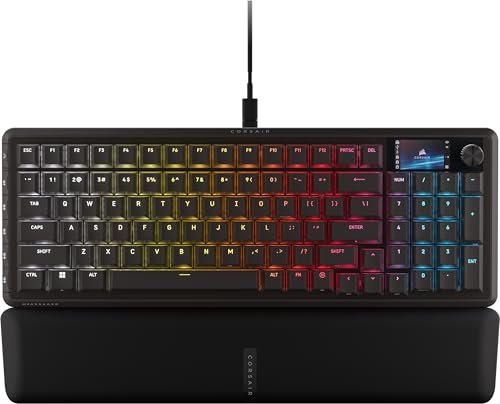
Best 96% Wired
Corsair Vanguard 96 Gaming Keyboard
8000Hz in a 96% frame.
Best for: Wired setups.
Our take Check price for Corsair Vanguard 96 Gaming Keyboard (opens in a new tab)

Best Wired Value
ASUS TUF Gaming K3 Gen II
Optical-mechanical switches with PBT.
Best for: Mid budgets.
Our take Check price for ASUS TUF Gaming K3 Gen II (opens in a new tab)
Our Picks
Best Wireless 75%1 of 6
ASUS ROG Azoth Wireless on Amazon (opens in a new tab)
The ROG Azoth is ASUS's enthusiast 75% board: gasket-mounted with three layers of foam, hot-swappable, and wireless over 2.4GHz or Bluetooth.
Best for
- Compact desks.
Skip if
- Skip it if price comes first: the TUF K3 Gen II cost less when we checked.
Why we like it
A small OLED display shows settings and battery. On battery life it leads this guide at 2000 hours, ahead of the K10 Ultra 8K (760 hours). It shares a 75% layout with the K65 Plus Wireless; the Vanguard 96 goes with a 96% layout.
It shares double-shot PBT keycaps with the G515 TKL; the TUF K3 Gen II goes with PBT keycaps. It also offers a hot-swap PCB with a switch and keycap kit. Use the ROG Azoth's dongle or cable for games; Bluetooth suits a laptop or tablet.
At our last price check it topped the group, with the K65 Plus Wireless the nearest cheaper option. If you want a confirmed polling rate, look to the K10 Ultra 8K instead: it offers 8,000Hz, while this one gives no figure.
Key dimensions & specs
- Layout: 75%
- Switches: ROG NX Snow linear or NX Storm clicky
- Connection: 2.4GHz, Bluetooth, wired
- Battery life: 2000 hours
- Keycaps: Double-shot PBT
Pros
- Compact 75% layout
- ROG NX Snow linear or NX Storm clicky switches
- Dongle, Bluetooth and wired modes
- Up to 2000 hours per charge
Cons
- Costs more than the TUF K3 Gen II at the time of writing
Best Full-Size 8K2 of 6
Keychron K10 Ultra 8K on Amazon (opens in a new tab)
The Keychron K10 Ultra 8K is a full-size wireless board that offers 8000Hz polling over both cable and 2.4GHz.
Best for
- Number-pad users.
Skip if
- Skip it if this is a deal-breaker for you: full-size board takes more desk width.
Why we like it
Keychron quotes up to 760 hours of battery with the backlight off. Its 760 hours battery life ranks second of 4 here, behind the ROG Azoth (2000 hours) and ahead of the G515 TKL (36 hours). A full-size (100%) layout is unique to it among these picks, while the K65 Plus Wireless uses a 75% layout.
It also comes with ZMK firmware for remapping and Bluetooth pairing with three devices. Use the K10 Ultra 8K's dongle or cable for games; Bluetooth suits a laptop or tablet. High polling rates use more CPU time; drop to 1,000Hz if an older system stutters. It was priced above the TUF K3 Gen II and below the G515 TKL at the time of writing.
Key dimensions & specs
- Layout: Full-size (100%)
- Connection: 2.4GHz, Bluetooth, wired
- Polling rate: 8,000Hz
- Battery life: 760 hours
Pros
- Dongle, Bluetooth and wired modes
- 8,000Hz polling
- Up to 760 hours per charge
- 8000Hz polling in both wired and 2.4GHz modes
Cons
- Full-size board takes more desk width
- Costs more than the TUF K3 Gen II at the time of writing
Best Battery3 of 6
Corsair K65 Plus Wireless 75% Keyboard on Amazon (opens in a new tab)
The K65 Plus Wireless is the long-distance runner: a 75% layout, MLX Red switches and a 266 hours per charge.
Best for
- Rare charging.
Skip if
- If budget leads, the TUF K3 Gen II was cheaper at our last price check.
Why we like it
Its pre-lubricated MLX Red linear switches feel smooth, and it runs up to 266 hours per charge with RGB off. Connections over 2.4GHz, Bluetooth or USB use AES encryption. On battery life it sits mid-pack at 266 hours: the ROG Azoth runs for 2000 hours, and the G515 TKL comes in at 36 hours.
Like the ROG Azoth, it has a 75% layout, while the TUF K3 Gen II uses a 97-key compact layout. No other pick in this guide offers MLX Red linear switches; compare the G515 TKL, which has tactile switches. Like the TUF K3 Gen II, it has PBT keycaps, while the ROG Azoth uses double-shot PBT keycaps.
It also comes with a gasket-mounted design. Its price falls between the Vanguard 96 and the ROG Azoth, based on our last check. Buyers who need a confirmed polling rate should compare it with the K10 Ultra 8K, which offers 8,000Hz.
Key dimensions & specs
- Layout: 75%
- Switches: MLX Red linear
- Connection: Slipstream 2.4GHz, Bluetooth, wired
- Battery life: 266 hours
- Keycaps: PBT
Pros
- Compact 75% layout
- MLX Red linear switches
- Dongle, Bluetooth and wired modes
- Up to 266 hours per charge
Cons
- Costs more than the TUF K3 Gen II at the time of writing
Best Low-Profile TKL4 of 6
Logitech G515 Lightspeed TKL Wireless Keyboard on Amazon (opens in a new tab)
The G515 TKL is Logitech's most flexible board for its price: three connection modes, PBT keycaps and a slim profile.
Best for
- Flat typing.
Skip if
- Choose another pick if you can't accept this: shorter 36-hour battery.
Why we like it
Its 36-hour battery is the trade. Its low-profile GL Brown switches are factory-lubed for a smoother tactile press, and it connects over LIGHTSPEED, Bluetooth or USB. The slim tenkeyless body frees mouse space.
It is rated for up to 36 hours on a charge, and double-shot PBT keycaps resist shine. KEYCONTROL assigns up to 15 functions per key. Its 36 hours battery life is the shortest in this group; the ROG Azoth leads at 2000 hours.
Tactile switches is unique to it among these picks, while the TUF K3 Gen II uses optical-mechanical switches. It shares double-shot PBT keycaps with the ROG Azoth; the TUF K3 Gen II goes with PBT keycaps. When we checked, only the K10 Ultra 8K and cheaper picks cost less, and the Vanguard 96 cost more. If you want a confirmed polling rate, look to the K10 Ultra 8K instead: it offers 8,000Hz, while this one gives no figure.
Key dimensions & specs
- Layout: TKL, low-profile
- Switches: Tactile
- Connection: Lightspeed, Bluetooth, wired
- Battery life: 36 hours
- Keycaps: Double-shot PBT
Pros
- Tenkeyless layout leaves more room for the mouse
- Tactile switches
- Dongle, Bluetooth and wired modes
- PBT keycaps resist shine
Cons
- Shorter 36-hour battery
- Battery life trails the ROG Azoth (2000 hours)
- Costs more than the TUF K3 Gen II at the time of writing
Best 96% Wired5 of 6
Corsair Vanguard 96 Gaming Keyboard on Amazon (opens in a new tab)
The Vanguard 96 keeps a number pad in a compressed layout and adds a small display and 8,000Hz polling.
Best for
- Wired setups.
Skip if
- Pass on it if wired onl rules it out for your setup.
Why we like it
It maps Stream Deck functions to programmable G-keys, polls at 8,000Hz, and FlashTap SOCD resolves opposing key presses. A 1.9-inch LCD shows custom images or system info. It is the only pick here with a 96% layout; the ROG Azoth has a 75% layout instead.
The Vanguard 96 needs a free USB port, so check cable length to your case or monitor hub. High polling rates use more CPU time; drop to 1,000Hz if an older system stutters. Its price falls between the G515 TKL and the K65 Plus Wireless, based on our last check. Buyers who need a confirmed battery life should compare it with the ROG Azoth, which runs for 2000 hours.
Key dimensions & specs
- Layout: 96%
- Connection: Wired
- Polling rate: 8,000Hz
Pros
- 8,000Hz polling
- Built-in display
- 96% layout that keeps the number pad in a smaller frame
Cons
- Wired only
- Costs more than the TUF K3 Gen II at the time of writing
Best Wired Value6 of 6
ASUS TUF Gaming K3 Gen II on Amazon (opens in a new tab)
ASUS's TUF K3 Gen II is a 97-key wired board with optical-mechanical switches, PBT keycaps and an IP57 rating against water and dust.
Best for
- Mid budgets.
Skip if
- Look at the others if this bothers you: wired only.
Why we like it
A gasket mount and foam are unusual at its price. It is the only pick here with a 97-key compact layout; the ROG Azoth has a 75% layout instead. No other pick in this guide offers optical-mechanical switches; compare the K65 Plus Wireless, which has MLX Red linear switches.
Like the K65 Plus Wireless, it has PBT keycaps, while the ROG Azoth uses double-shot PBT keycaps. It also offers a detachable top plate. The TUF K3 Gen II needs a free USB port, so check cable length to your case or monitor hub.
It was the cheapest of the group when we checked; the K10 Ultra 8K was the next step up. Buyers who need a confirmed polling rate should compare it with the K10 Ultra 8K, which offers 8,000Hz.
Key dimensions & specs
- Layout: 97-key compact
- Switches: Optical-mechanical
- Connection: Wired
- Keycaps: PBT
Pros
- Optical-mechanical switches
- PBT keycaps resist shine
- IP57 water and dust resistance
- Silicone gasket mount with dampening foam
Cons
- Wired only
How We Chose These Mechanical Keyboards for Gaming
Each pick was assessed across 4 criteria weighted for real-world use.
- Layout and switches
- We recorded the layout, the switch type and whether the switches are mechanical, magnetic or membrane.
- Polling rate
- We recorded polling rates where listings state them.
- Connection
- We checked wired, dongle and Bluetooth options and rated battery life.
- Build
- We noted keycap material, frame material and extra controls such as knobs or screens.
What to Look for in a Mechanical Keyboard for Gaming
Key buying criteria so you get the right fit the first time.
Choose the layout before the switch
Full-size boards keep the number pad; tenkeyless drops it and gives the mouse more room. 75% and 65% boards keep arrows in a tighter frame, while 60% boards move arrows and F-keys to a function layer.
Wired, dongle or Bluetooth
A 2.4GHz dongle is fine for games; Bluetooth adds latency and suits typing on other devices. Wired boards never need charging.
Polling rate is a small factor
1,000Hz is enough for most players. 8,000Hz cuts reporting delay further, but the gain is small and uses more CPU time.
Keycap material lasts longer than lighting
PBT keycaps resist the shine that ABS caps develop. Double-shot legends do not wear off.
Hot-swap sockets allow switch changes
Hot-swappable boards let you pull and replace switches without soldering. Check whether the sockets take 3-pin or 5-pin switches.
Linear, tactile or magnetic
Linear switches travel smoothly, tactile switches have a bump, and clicky switches add a click. Hall effect switches read a magnet, so actuation can be adjusted and rapid trigger resets a key as soon as it rises.
How to Choose a Mechanical Keyboard for Gaming
By priority
| Priority | Consider | Why |
|---|---|---|
| Compact desks | ROG Azoth | Tri-mode with double-shot PBT |
| Number-pad users | K10 Ultra 8K | 8000Hz on a full-size wireless board |
| Rare charging | K65 Plus Wireless | 266 hours of listed battery life |
| Flat typing | G515 TKL | Lightspeed, Bluetooth and PBT caps |
| Wired setups | Vanguard 96 | 8000Hz in a 96% frame |
| Mid budgets | TUF K3 Gen II | Optical-mechanical switches with PBT |
Scroll sideways to see every column.
Key specs side by side
Figures as each maker states them.
| Keyboard | Layout | Switches | Connection | Polling rate |
|---|---|---|---|---|
| ROG Azoth | 75% | ROG NX Snow linear or NX Storm clicky | 2.4GHz, Bluetooth, wired | Not listed |
| K10 Ultra 8K | Full-size (100%) | Not listed | 2.4GHz, Bluetooth, wired | 8,000Hz |
| K65 Plus Wireless | 75% | MLX Red linear | Slipstream 2.4GHz, Bluetooth, wired | Not listed |
| G515 TKL | TKL, low-profile | Tactile | Lightspeed, Bluetooth, wired | Not listed |
| Vanguard 96 | 96% | Not listed | Wired | 8,000Hz |
| TUF K3 Gen II | 97-key compact | Optical-mechanical | Wired | Not listed |
Scroll sideways to see every column.
By price at the time of writing
Prices change often; these tiers reflect Amazon prices when this guide was updated.
| Price tier | Keyboards |
|---|---|
| About $50 to $100 | TUF K3 Gen II |
| About $100 to $150 | K10 Ultra 8K, G515 TKL, Vanguard 96 |
| About $150 to $250 | K65 Plus Wireless, ROG Azoth |
Frequently Asked Questions
Do Hall effect switches help in games?
Adjustable actuation and rapid trigger help most in fast strafing games. In slower games the difference is small.
Do these keyboards need software?
They work without it, but lighting, macros and actuation settings usually need the maker's app.
Is a membrane keyboard bad for gaming?
No. It is quieter and cheaper, but it feels softer and usually lacks per-key rollover guarantees beyond what the listing states.
Should I pick tenkeyless or full-size?
Tenkeyless if you want more mouse room and rarely type numbers; full-size if you enter numbers often.
Is a wireless keyboard slower?
Not over a 2.4GHz dongle for most players. Bluetooth adds more latency and is better kept for other devices.
Do I need 8,000Hz polling?
No. It is a marginal gain on top of 1,000Hz and can cost battery life and CPU time.
Bottom Line
ASUS's ROG Azoth is the wireless 75% pick. Keychron's K10 Ultra 8K is the full-size choice, and the TUF K3 Gen II is the wired value option.