
Buying Guide
The Best Large Gaming Monitors
Six monitors from 37 to 49 inches, from 43-inch 4K screens to 49-inch ultrawides.
By The PC Journal editorial team
12 min read6 products evaluated
Past 32 inches, a monitor becomes either a 4K TV-sized screen or a super-ultrawide. These six cover both shapes.
We compared size, resolution and HDR from each listing.
Quick Picks
Our 6 recommendations at a glance. Tap a pick for the full verdict.

Best Super-Ultrawide
Samsung Odyssey OLED G9 (G91SD) 49-inch
A 49-inch QD-OLED at 5120x1440.
Best for: Racing and flight games.
Our take Check price for Samsung Odyssey OLED G9 (G91SD) 49-inch (opens in a new tab)

Best 43-Inch 4K
Samsung Odyssey Neo G7 43-inch Smart
Mini LED with DisplayHDR 600.
Best for: Big-screen HDR.
Our take Check price for Samsung Odyssey Neo G7 43-inch Smart (opens in a new tab)

Best 43-Inch Value
INNOCN 43-inch 4K 144Hz
43-inch 4K at 144Hz with USB-C.
Best for: Big screens for less.
Our take Check price for INNOCN 43-inch 4K 144Hz (opens in a new tab)

Fastest Refresh
Samsung Odyssey G7 (G75F) 40-inch WUHD
The highest refresh rate here (180Hz).
Best for: Competitive shooters where motion clarity matters most.
Our take Check price for Samsung Odyssey G7 (G75F) 40-inch WUHD (opens in a new tab)
Best 37-Inch
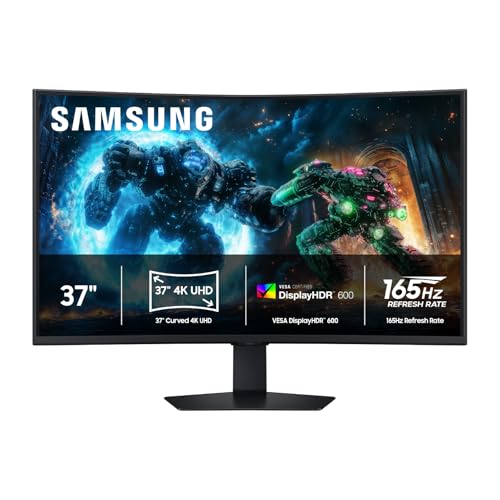
Samsung Odyssey G7 (G75F) 37-inch
4K at 165Hz with DisplayHDR 600.
Best for: Desks that can't fit 43 inches.
Our take Check price for Samsung Odyssey G7 (G75F) 37-inch (opens in a new tab)
Best VA Super-Ultrawide
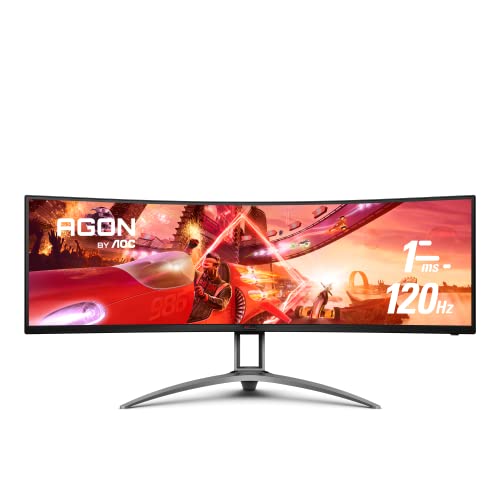
AOC AGON AG493UCX 49-inch
A 49-inch VA screen with USB-C.
Best for: Ultrawide without OLED.
Our take Check price for AOC AGON AG493UCX 49-inch (opens in a new tab)
Our Picks
Best Super-Ultrawide1 of 6
Samsung Odyssey OLED G9 (G91SD) 49-inch on Amazon (opens in a new tab)
Samsung's Odyssey OLED G9 is a 49-inch 5120x1440 QD-OLED at 144Hz.
Best for
- Racing and flight games.
Skip if
- Look at the others if this bothers you: oLED burn-in risk with static desktop elements.
Why we like it
It replaces two 27-inch 1440p screens with one curved panel. It matches the Odyssey Neo G7 43 and the INNOCN 43 on refresh rate (144Hz). On screen size it ties with the AG493UCX at 49 inches.
Like the AG493UCX, it has a 5120x1440 resolution, while the Odyssey G7 40 uses a 5120x2160 resolution. You also get a height-adjustable stand. Leave the maker's pixel-refresh routines enabled and hide static taskbars to limit burn-in risk. It was the highest-priced of the 6 picks at the time of writing, so the case for it rests on what it adds over the Odyssey Neo G7 43 and the rest.
Key dimensions & specs
- Refresh rate: 144Hz
- Resolution: 5120x1440
- Size: 49 inches
- Panel: QD-OLED
- Response: 0.03ms
Pros
- 144Hz for smoother motion than a 60Hz office screen
- a QD-OLED panel with per-pixel contrast
- 49-inch Dual QHD panel
- 110 pixels per inch
Cons
- OLED burn-in risk with static desktop elements
- Costs more than the INNOCN 43 at the time of writing
Best 43-Inch 4K2 of 6
Samsung Odyssey Neo G7 43-inch Smart on Amazon (opens in a new tab)
Samsung's Odyssey Neo G7 43 is a 43-inch 4K Mini LED screen at 144Hz with built-in Smart TV apps.
Best for
- Big-screen HDR.
Skip if
- Skip it if price comes first: the INNOCN 43 cost less when we checked.
Why we like it
The maker says the picture can shrink to a smaller on-screen size. It matches the Odyssey OLED G9 and the INNOCN 43 on refresh rate (144Hz). On screen size it ties with the INNOCN 43 at 43 inches.
Like the INNOCN 43 and Odyssey G7 37, it has a 3840x2160 (4K) resolution, while the AG493UCX uses a 5120x1440 resolution. You also get Quantum Mini LED backlighting and an adjustable on-screen size from 43 down to 20 inches. Reaching 144Hz at 4K needs DisplayPort 1.4 with DSC or HDMI 2.1 on your graphics card, and a GPU able to render well above 100fps at 4K. On price it sat fifth of 6, between the cheaper Odyssey G7 40 and the pricier Odyssey OLED G9, at the time of writing.
Key dimensions & specs
- Refresh rate: 144Hz
- Resolution: 3840x2160 (4K)
- Size: 43 inches
- Response: 1ms
- HDR: DisplayHDR 600
Pros
- 144Hz for smoother motion than a 60Hz office screen
- 4K resolution for sharp text and detail
- DisplayHDR 600 certification
- Built-in Smart TV apps
Cons
- Costs more than the INNOCN 43 at the time of writing
Best 43-Inch Value3 of 6
INNOCN 43-inch 4K 144Hz on Amazon (opens in a new tab)
INNOCN's 43-inch 4K monitor runs at 144Hz with built-in speakers, USB-C and a height-adjustable stand.
Best for
- Big screens for less.
Skip if
- Worth skipping when refresh rate of 144Hz, behind the Odyssey G7 40 (180Hz is a problem.
Why we like it
It is a lower-cost way to a TV-sized desktop screen. On refresh rate it ties with the Odyssey OLED G9 and the Odyssey Neo G7 43 at 144Hz. It matches the Odyssey Neo G7 43 on screen size (43 inches).
It shares a 3840x2160 (4K) resolution with the Odyssey Neo G7 43 and Odyssey G7 37; the Odyssey OLED G9 goes with a 5120x1440 resolution. You get an HDR400 here, which sets it apart from the AG493UCX and its a DisplayHDR 400. It also offers USB-C input.
Reaching 144Hz at 4K needs DisplayPort 1.4 with DSC or HDMI 2.1 on your graphics card, and a GPU able to render well above 100fps at 4K. It cost the least of the 6 picks at the time of writing, with the Odyssey G7 37 the next step up. What it gives up: refresh rate of 144Hz, behind the Odyssey G7 40 (180Hz); by contrast, the Odyssey G7 40 offers 180Hz.
Key dimensions & specs
- Refresh rate: 144Hz
- Resolution: 3840x2160 (4K)
- Size: 43 inches
- HDR: HDR400
- Stand: height adjustment
- USB-C: Yes
Pros
- 144Hz for smoother motion than a 60Hz office screen
- 4K resolution for sharp text and detail
- a stand with height adjustment
- a USB-C input for laptops
Cons
- Refresh rate of 144Hz, behind the Odyssey G7 40 (180Hz)
Fastest Refresh4 of 6
Samsung Odyssey G7 (G75F) 40-inch WUHD on Amazon (opens in a new tab)
Samsung's Odyssey G7 40 is a 40-inch 5120x2160 ultrawide at 180Hz with DisplayHDR 600.
Best for
- Competitive shooters where motion clarity matters most.
Skip if
- Price-first buyers should look at the INNOCN 43, which cost less when we checked.
Why we like it
It has the widest 4K-class canvas among these monitors. Its 40-inch WUHD panel is DisplayHDR 600 certified and refreshes at 180Hz with 1ms GtG response. Nothing else here matches its 180Hz refresh rate; the Odyssey G7 37 comes closest at 165Hz.
On screen size it sits mid-pack at 40 inches: the Odyssey OLED G9 comes in at 49 inches, and the Odyssey G7 37 comes in at 37 inches. No other pick in this guide offers a 5120x2160 resolution; compare the AG493UCX, which has a 5120x1440 resolution. Like the Odyssey Neo G7 43 and Odyssey G7 37, it has a DisplayHDR 600, while the INNOCN 43 uses an HDR400.
It also comes with a 40-inch 21:9 1000R curve. On price it sat fourth of 6, between the cheaper AG493UCX and the pricier Odyssey Neo G7 43, at the time of writing.
Key dimensions & specs
- Refresh rate: 180Hz
- Resolution: 5120x2160
- Size: 40 inches
- Response: 1ms
- HDR: DisplayHDR 600
Pros
- 180Hz for smoother motion than a 60Hz office screen
- DisplayHDR 600 certification
- 40-inch 21:9 1000R curve
- Screen size of 40 inches, ahead of the Odyssey G7 37
Cons
- Costs more than the INNOCN 43 at the time of writing
Best 37-Inch5 of 6
Samsung Odyssey G7 (G75F) 37-inch on Amazon (opens in a new tab)
Samsung's Odyssey G7 37 is a 37-inch 4K screen at 165Hz with DisplayHDR 600.
Best for
- Desks that can't fit 43 inches.
Skip if
- Skip it if screen size matters most to you; the Odyssey OLED G9 offers 49 inches.
Why we like it
It sits between a 32-inch monitor and a TV in size. Its 165Hz refresh rate ranks second of 6 here, behind the Odyssey G7 40 (180Hz) and ahead of the AG493UCX (120Hz). On screen size it trails the group at 37 inches, while the Odyssey OLED G9 comes in at 49 inches.
Like the Odyssey Neo G7 43 and INNOCN 43, it has a 3840x2160 (4K) resolution, while the Odyssey OLED G9 uses a 5120x1440 resolution. It also comes with a 37-inch 1000R curve. Reaching 165Hz at 4K needs DisplayPort 1.4 with DSC or HDMI 2.1 on your graphics card, and a GPU able to render well above 100fps at 4K. On price it sat second of 6, between the cheaper INNOCN 43 and the pricier AG493UCX, at the time of writing.
Key dimensions & specs
- Refresh rate: 165Hz
- Resolution: 3840x2160 (4K)
- Size: 37 inches
- Response: 1ms
- HDR: DisplayHDR 600
Pros
- 165Hz for smoother motion than a 60Hz office screen
- 4K resolution for sharp text and detail
- DisplayHDR 600 certification
- 37-inch 1000R curve
Cons
- Screen size trails the Odyssey OLED G9 (49 inches)
- Costs more than the INNOCN 43 at the time of writing
Best VA Super-Ultrawide6 of 6
AOC AGON AG493UCX 49-inch on Amazon (opens in a new tab)
AOC's AG493UCX is a 49-inch 5120x1440 VA screen at 120Hz with USB-C and DisplayHDR 400.
Best for
- Ultrawide without OLED.
Skip if
- Choose another pick if you can't accept this: a VA panel that can smear dark transitions.
Why we like it
It is the non-OLED super-ultrawide here. Its 120Hz refresh rate is the lowest in this group; the Odyssey G7 40 leads at 180Hz. On screen size it ties with the Odyssey OLED G9 at 49 inches.
Like the Odyssey OLED G9, it has a 5120x1440 resolution, while the Odyssey G7 40 uses a 5120x2160 resolution. No other pick in this guide offers a DisplayHDR 400; compare the Odyssey G7 40, which has a DisplayHDR 600. It also comes with an 1800R 49-inch curve, USB-C docking and Dual QHD resolution. On price it sat third of 6, between the cheaper Odyssey G7 37 and the pricier Odyssey G7 40, at the time of writing.
Key dimensions & specs
- Refresh rate: 120Hz
- Resolution: 5120x1440
- Size: 49 inches
- Panel: VA
- Response: 1ms
- HDR: DisplayHDR 400
- Adaptive sync: Adaptive-Sync
- USB-C: Yes
Pros
- Adaptive-Sync to reduce screen tearing
- a USB-C input for laptops
- 1800R 49-inch curve
- USB-C docking
Cons
- a VA panel that can smear dark transitions
- Refresh rate trails the Odyssey G7 40 (180Hz)
- Costs more than the INNOCN 43 at the time of writing
How We Chose These Large Gaming Monitors
Each pick was assessed across 4 criteria weighted for real-world use.
- Panel
- We noted panel type and the trade-offs it brings for motion, contrast and burn-in.
- Connectivity and stand
- We checked ports, USB-C and stand adjustment where the listing states them.
- Resolution and refresh
- We compared listed resolution and refresh rate against the graphics power each needs.
- HDR and colour
- We recorded DisplayHDR certifications and listed colour gamut.
What to Look for in a Large Gaming Monitor
Key buying criteria so you get the right fit the first time.
Size for your desk distance
24 to 25 inches suits 1080p and competitive play at a typical desk. 27 inches pairs well with 1440p and 4K; 32 inches suits 4K at a deeper desk.
Match resolution to your graphics card
1080p suits entry and mid-range cards and high refresh rates. 1440p is the balance for most gaming PCs. 4K needs a high-end card to hold high frame rates.
Pick the resolution your card can drive before looking at refresh rate.
Read HDR labels carefully
HDR10 means the monitor accepts an HDR signal, not that it displays it well. DisplayHDR 600 or True Black 400 certifications say more about real HDR performance.
Check ports and cables
High refresh rates at 1440p and 4K need DisplayPort 1.4 or HDMI 2.1. Consoles need HDMI 2.1 for 4K at 120Hz.
Pick the panel type
IPS offers wide viewing angles and good colour. VA has higher contrast but slower dark transitions. OLED has perfect blacks and very fast response but carries a burn-in risk with static content.
Consider the stand
A stand with height, tilt and swivel adjustment saves buying a monitor arm. Check VESA mounting if you plan to use one anyway.
How to Choose a Large Gaming Monitor
By priority
| Priority | Consider | Why |
|---|---|---|
| Racing and flight games | Odyssey OLED G9 | A 49-inch QD-OLED at 5120x1440 |
| Big-screen HDR | Odyssey Neo G7 43 | Mini LED with DisplayHDR 600 |
| Big screens for less | INNOCN 43 | 43-inch 4K at 144Hz with USB-C |
| Competitive shooters where motion clarity matters most | Odyssey G7 40 | The highest refresh rate here (180Hz) |
| Desks that can't fit 43 inches | Odyssey G7 37 | 4K at 165Hz with DisplayHDR 600 |
| Ultrawide without OLED | AG493UCX | A 49-inch VA screen with USB-C |
Scroll sideways to see every column.
Key specs side by side
Figures as each maker states them.
| Monitor | Refresh rate | Resolution | Size | Panel |
|---|---|---|---|---|
| Odyssey OLED G9 | 144Hz | 5120x1440 | 49 inches | QD-OLED |
| Odyssey Neo G7 43 | 144Hz | 3840x2160 (4K) | 43 inches | Not listed |
| INNOCN 43 | 144Hz | 3840x2160 (4K) | 43 inches | Not listed |
| Odyssey G7 40 | 180Hz | 5120x2160 | 40 inches | Not listed |
| Odyssey G7 37 | 165Hz | 3840x2160 (4K) | 37 inches | Not listed |
| AG493UCX | 120Hz | 5120x1440 | 49 inches | VA |
Scroll sideways to see every column.
By price at the time of writing
Prices change often; these tiers reflect Amazon prices when this guide was updated.
| Price tier | Monitors |
|---|---|
| About $250 to $500 | INNOCN 43 |
| About $500 to $1000 | Odyssey G7 37, AG493UCX, Odyssey G7 40, Odyssey Neo G7 43 |
| About $1000 to $1500 | Odyssey OLED G9 |
Frequently Asked Questions
Does a 1ms response time rating matter?
Makers measure response time differently, so compare panel type and independent reviews rather than the headline figure.
Do I need a GPU that matches the refresh rate?
To benefit fully, yes. A 240Hz monitor still feels smoother at 150fps than a 144Hz one, but the gains shrink when frame rates are far below the refresh rate.
Is 1080p fine on a 27-inch monitor?
It works, but text and detail look softer. 1440p is sharper at 27 inches; 1080p is best at 24 to 25 inches.
Is HDR worth it on a budget monitor?
Rarely. Budget HDR10 monitors accept HDR but lack the brightness and contrast to show it well. OLED or DisplayHDR 600 models do it better.
Is OLED burn-in still a problem?
It is a risk with static elements over many hours. Current OLED monitors use pixel-refresh routines to reduce it; check the maker's warranty for burn-in coverage.
Does a FreeSync monitor work with an NVIDIA card?
Most do as G-SYNC Compatible over DisplayPort. Check the product page or NVIDIA's compatibility list for the model.
Bottom Line
Samsung's Odyssey OLED G9 is the high-end super-ultrawide. The Neo G7 43 is the big 4K screen, and INNOCN's 43-inch model costs less.