
Buying Guide
Good Video Cards for a Gaming PC
Six solid cards across price tiers, each matched to a resolution, so you can pick by the monitor you own.
By The PC Journal editorial team
12 min read6 products evaluated
A good card is one sized to your monitor. We matched each pick here to a resolution: 4K for the RTX 5070 Ti, 1440p for the RX 9070 XT, RTX 5070 and RX 9060 XT 16GB, and 1080p for the RTX 5060 and Arc B570.
Specifications come from each listing and the chipmakers; we did not benchmark these cards.
Quick Picks
Our 6 recommendations at a glance. Tap a pick for the full verdict.

Best All-Round Card
ASRock Radeon RX 9070 XT Challenger 16GB OC
An RX 9070 XT with 16GB and three DisplayPort 2.1a outputs.
Best for: 1440p and entry 4K.
Our take Check price for ASRock Radeon RX 9070 XT Challenger 16GB OC (opens in a new tab)

Best for 4K
MSI RTX 5070 Ti Ventus 3X PZ OC
An RTX 5070 Ti with 16GB of GDDR7.
Best for: 4K with DLSS.
Our take Check price for MSI RTX 5070 Ti Ventus 3X PZ OC (opens in a new tab)

Best 12GB NVIDIA Card
ASUS TUF Gaming GeForce RTX 5070 12GB GDDR7 OC Edition
An RTX 5070 with a 2640MHz OC-mode boost.
Best for: High-refresh 1440p.
Our take Check price for ASUS TUF Gaming GeForce RTX 5070 12GB GDDR7 OC Edition (opens in a new tab)
Best 16GB Mid-Range
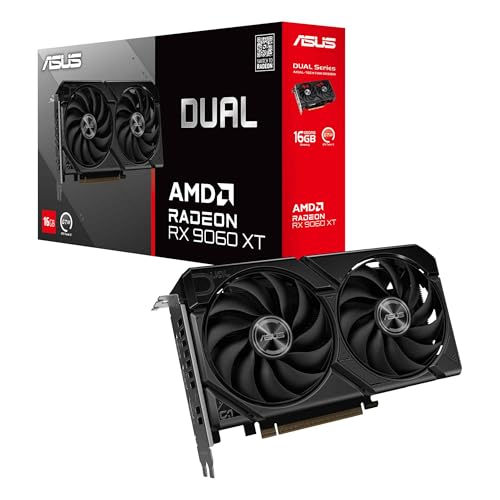
ASUS Dual Radeon RX 9060 XT 16GB
An RX 9060 XT with 16GB and a 3250MHz OC-mode boost.
Best for: 1440p on a budget.
Our take Check price for ASUS Dual Radeon RX 9060 XT 16GB (opens in a new tab)

Best for 1080p
ASUS Prime GeForce RTX 5060 8GB
An SFF-Ready RTX 5060 with 8GB of GDDR7.
Best for: 1080p in smaller cases.
Our take Check price for ASUS Prime GeForce RTX 5060 8GB (opens in a new tab)

Best Low-Cost Pick
ASRock Intel Arc B570 Challenger 10GB OC
10GB of GDDR6 and one 8-pin connector.
Best for: Tight budgets.
Our take Check price for ASRock Intel Arc B570 Challenger 10GB OC (opens in a new tab)
Our Picks
Best All-Round Card1 of 6
ASRock Radeon RX 9070 XT Challenger 16GB OC on Amazon (opens in a new tab)
ASRock's RX 9070 XT Challenger gives an all-AMD build 16GB of memory on a 256-bit bus and a triple-fan cooler with 0dB fan stop.
Best for
- 1440p and entry 4K.
Skip if
- Pass if a published cooler thickness matters; this one has none.
Why we like it
Three DisplayPort 2.1a outputs suit high-refresh monitors. On video memory it ties with the MSI Ventus 3X and the ASUS Dual 9060 XT 16GB at 16GB. An RX 9070 XT gpu is unique to it among these picks, while the ASUS TUF RTX 5070 uses an RTX 5070 gpu.
Like the ASUS Dual 9060 XT 16GB and Arc B570 Challenger, it has GDDR6 memory, while the MSI Ventus 3X uses GDDR7 memory. No other pick in this guide offers a 2970MHz boost clock; compare the MSI Ventus 3X, which has a 2482MHz boost clock. It also offers 64 compute units.
No dimensions are published for the ASRock RX 9070 XT Challenger; get length and thickness from the maker's page first. It was priced above the ASUS Dual 9060 XT 16GB and below the ASUS TUF RTX 5070 at the time of writing. There is no published cooler thickness figure, whereas the ASUS Dual 9060 XT 16GB comes in at 2.5-slot.
Key dimensions & specs
- GPU: RX 9070 XT
- VRAM: 16GB
- Memory: GDDR6
- Boost clock: 2970MHz
- Outputs: 3 x DisplayPort 2.1a, 1 x HDMI 2.1b
Pros
- 16GB of VRAM for high-resolution textures
- 64 compute units
- 256-bit memory bus
- Triple-fan cooler with 0dB fan stop
Cons
- No published cooler thickness
- Costs more than the Arc B570 Challenger at the time of writing
Best for 4K2 of 6
MSI RTX 5070 Ti Ventus 3X PZ OC on Amazon (opens in a new tab)
MSI's Ventus 3X PZ is an SFF-Ready card with three TORX Fan 5.0 fans and nickel-plated core pipes.
Best for
- 4K with DLSS.
Skip if
- Skip it if you need to know its cooler thickness before buying; the maker doesn't publish one.
Why we like it
It is one of the more affordable triple-fan RTX 5070 Ti models here. On video memory it ties with the ASRock RX 9070 XT Challenger and the ASUS Dual 9060 XT 16GB at 16GB. You get an RTX 5070 Ti gpu here, which sets it apart from the Arc B570 Challenger and its an arc B570 gpu.
Like the ASUS TUF RTX 5070 and ASUS Prime RTX 5060, it has GDDR7 memory, while the Arc B570 Challenger uses GDDR6 memory. It is the only pick here with a 2482MHz boost clock; the Arc B570 Challenger has a 2600MHz boost clock instead. At our last price check it topped the group, with the ASUS TUF RTX 5070 the nearest cheaper option. If you want a confirmed cooler thickness, look to the ASUS Dual 9060 XT 16GB instead: it comes in at 2.5-slot, while this one gives no figure.
Key dimensions & specs
- GPU: RTX 5070 Ti
- VRAM: 16GB
- Memory: GDDR7
- Boost clock: 2482MHz
- SFF-Ready: Yes
- Outputs: 3 x DisplayPort 2.1a, 1 x HDMI 2.1b
Pros
- 16GB of VRAM for high-resolution textures
- Faster GDDR7 memory
- Carries NVIDIA's SFF-Ready label
- Nickel-plated square core pipes
Cons
- No published cooler thickness
- Costs more than the Arc B570 Challenger at the time of writing
Best 12GB NVIDIA Card3 of 6
ASUS TUF Gaming GeForce RTX 5070 12GB GDDR7 OC Edition on Amazon (opens in a new tab)
The ASUS TUF RTX 5070 trades size for cooling, with a 3.125-slot heatsink and three axial fans.
Best for
- High-refresh 1440p.
Skip if
- Choose another pick if you can't accept this: its 3.125-slot cooler covers the slots below.
Why we like it
The GPU Guard bracket helps against sag and the PCB carries a protective coating. Its 12GB video memory ranks fourth of 6 here, behind the ASRock RX 9070 XT Challenger (16GB) and ahead of the ASUS Prime RTX 5060 (8GB). On cooler thickness it trails the group at 3.125-slot, while the ASUS Dual 9060 XT 16GB comes in at 2.5-slot.
No other pick in this guide offers an RTX 5070 gpu; compare the ASUS Dual 9060 XT 16GB, which has an RX 9060 XT gpu. It shares GDDR7 memory with the MSI Ventus 3X and ASUS Prime RTX 5060; the Arc B570 Challenger goes with GDDR6 memory. You get a 2640MHz (OC mode) boost clock here, which sets it apart from the MSI Ventus 3X and its a 2482MHz boost clock. On price it sat fifth of 6, between the cheaper ASRock RX 9070 XT Challenger and the pricier MSI Ventus 3X, at the time of writing.
Key dimensions & specs
- GPU: RTX 5070
- VRAM: 12GB
- Memory: GDDR7
- Thickness: 3.125-slot
- Boost clock: 2640MHz (OC mode)
Pros
- 12GB of VRAM, more than 8GB cards
- Faster GDDR7 memory
- Military-grade components and a protective PCB coating
- ASUS GPU Guard bracket against sag
Cons
- Its 3.125-slot cooler covers the slots below
- Cooler thickness trails the ASUS Dual 9060 XT 16GB (2.5-slot)
- Costs more than the Arc B570 Challenger at the time of writing
Best 16GB Mid-Range4 of 6
ASUS Dual Radeon RX 9060 XT 16GB on Amazon (opens in a new tab)
The ASUS Dual RX 9060 XT 16GB offers a 3250MHz boost in OC mode with Quiet and Performance BIOS profiles and 0dB fan stop.
Best for
- 1440p on a budget.
Skip if
- Price-first buyers should look at the Arc B570 Challenger, which cost less when we checked.
Why we like it
On video memory it ties with the ASRock RX 9070 XT Challenger and the MSI Ventus 3X at 16GB. It matches the ASUS Prime RTX 5060 on cooler thickness (2.5-slot). An RX 9060 XT gpu is unique to it among these picks, while the ASUS TUF RTX 5070 uses an RTX 5070 gpu.
Like the ASRock RX 9070 XT Challenger and Arc B570 Challenger, it has GDDR6 memory, while the MSI Ventus 3X uses GDDR7 memory. No other pick in this guide offers a 3250MHz (OC mode) boost clock; compare the MSI Ventus 3X, which has a 2482MHz boost clock. The ASUS Dual 9060 XT 16GB occupies 2.5 slots, but no length is published, so check the maker's spec page against your case. It was priced above the ASUS Prime RTX 5060 and below the ASRock RX 9070 XT Challenger at the time of writing.
Key dimensions & specs
- GPU: RX 9060 XT
- VRAM: 16GB
- Memory: GDDR6
- Thickness: 2.5-slot
- Boost clock: 3250MHz (OC mode)
Pros
- 16GB of VRAM for high-resolution textures
- Dual BIOS switch with Quiet and Performance profiles
- 0dB fan stop at light load
- Cooler thickness of 2.5-slot, ahead of the ASUS TUF RTX 5070
Cons
- Costs more than the Arc B570 Challenger at the time of writing
Best for 1080p5 of 6
ASUS Prime GeForce RTX 5060 8GB on Amazon (opens in a new tab)
The ASUS Prime RTX 5060 is a well-rounded 1080p card: GDDR7 memory, a quiet/performance BIOS switch and 0dB fan stop in a 2.5-slot, SFF-Ready design.
Best for
- 1080p in smaller cases.
Skip if
- Choose another pick if you can't accept this: 8GB of VRAM may force lower texture settings in some recent games.
Why we like it
On video memory it trails the group at 8GB, while the ASRock RX 9070 XT Challenger offers 16GB. It matches the ASUS Dual 9060 XT 16GB on cooler thickness (2.5-slot). You get an RTX 5060 gpu here, which sets it apart from the ASUS Dual 9060 XT 16GB and its an RX 9060 XT gpu.
Like the MSI Ventus 3X and ASUS TUF RTX 5070, it has GDDR7 memory, while the Arc B570 Challenger uses GDDR6 memory. It is the only pick here with a 2527MHz (OC mode) boost clock; the ASUS Dual 9060 XT 16GB has a 3250MHz (OC mode) boost clock instead. It also comes with dual-ball fan bearings.
The ASUS Prime RTX 5060 occupies 2.5 slots, but no length is published, so check the maker's spec page against your case. When we checked, only the Arc B570 Challenger cost less, and the ASUS Dual 9060 XT 16GB cost more.
Key dimensions & specs
- GPU: RTX 5060
- VRAM: 8GB
- Memory: GDDR7
- Thickness: 2.5-slot
- Boost clock: 2527MHz (OC mode)
- SFF-Ready: Yes
Pros
- Faster GDDR7 memory
- Carries NVIDIA's SFF-Ready label
- Quiet/performance dual BIOS switch
- 0dB fan stop
Cons
- 8GB of VRAM may force lower texture settings in some recent games
- Video memory trails the ASRock RX 9070 XT Challenger (16GB)
- Costs more than the Arc B570 Challenger at the time of writing
Best Low-Cost Pick6 of 6
ASRock Intel Arc B570 Challenger 10GB OC on Amazon (opens in a new tab)
The Arc B570 is the B580's cheaper sibling with 10GB of memory on a 160-bit bus.
Best for
- Tight budgets.
Skip if
- Pass if a published cooler thickness matters; this one has none.
Why we like it
It was the least expensive card here at the time of writing and still offers three DisplayPort 2.1 outputs. On video memory it sits mid-pack at 10GB: the ASRock RX 9070 XT Challenger offers 16GB, and the ASUS Prime RTX 5060 comes in at 8GB. An arc B570 gpu is unique to it among these picks, while the ASUS Prime RTX 5060 uses an RTX 5060 gpu.
Like the ASRock RX 9070 XT Challenger and ASUS Dual 9060 XT 16GB, it has GDDR6 memory, while the ASUS TUF RTX 5070 uses GDDR7 memory. No other pick in this guide offers a 2600MHz boost clock; compare the ASUS TUF RTX 5070, which has a 2640MHz (OC mode) boost clock. It cost the least of the 6 picks at the time of writing, with the ASUS Prime RTX 5060 the next step up. There is no published cooler thickness figure, whereas the ASUS Dual 9060 XT 16GB comes in at 2.5-slot.
Key dimensions & specs
- GPU: Arc B570
- VRAM: 10GB
- Memory: GDDR6
- Power connector: 1 x 8-pin
- Boost clock: 2600MHz
- Outputs: 3 x DisplayPort 2.1, 1 x HDMI 2.1a
Pros
- 10GB of VRAM, more than 8GB cards
- A single 8-pin power connector
- 160-bit memory bus at 19Gbps
- 0dB fan stop
Cons
- No published cooler thickness
How We Chose
Each pick was assessed across 4 criteria weighted for real-world use.
- Price tier
- We grouped picks by price at the time of writing rather than by listed clock speed.
- Fit
- We recorded length and slot thickness where the maker lists them, plus low-profile and SFF-Ready status.
- GPU and memory
- We compared the chip, video memory capacity and memory type stated in each listing.
- Cooling and extras
- We checked cooler design, fan-stop modes, dual BIOS, support brackets and display outputs.
What to Look For
Key buying criteria so you get the right fit the first time.
Match the card to your monitor
Resolution and refresh rate decide how much GPU you need. A 1080p screen at 144Hz asks far less than 1440p at 165Hz or 4K.
Buy for the monitor you use now or will buy soon, not for a resolution you may never run.
Treat 8GB of VRAM as the floor
Some recent games already push past 8GB at high texture settings. Cards with 12GB or 16GB give more room, especially at 1440p and above.
Two versions of the same chip can differ only in memory; check the capacity in the exact model name.
Check length and thickness
Partner cards of the same GPU can differ by several centimetres. Compare the card's length with the case's GPU clearance, allowing for front fans or a radiator, and check how many slots it covers.
Cooler size affects noise
Larger triple-fan coolers usually run quieter under load than compact dual-fan designs. A 0dB mode stops the fans at light load.
Pair it with a balanced CPU
A fast card with an old CPU can stall at high frame rates, especially at 1080p. At 4K the GPU does most of the work, so the CPU matters less.
Count the display outputs
Most cards offer three DisplayPort outputs and one HDMI, but some swap that balance. Check that the ports match your monitors, TV or VR headset.
How to Choose
By priority
| Priority | Consider | Why |
|---|---|---|
| 1440p and entry 4K | ASRock RX 9070 XT Challenger | An RX 9070 XT with 16GB and three DisplayPort 2.1a outputs |
| 4K with DLSS | MSI Ventus 3X | An RTX 5070 Ti with 16GB of GDDR7 |
| High-refresh 1440p | ASUS TUF RTX 5070 | An RTX 5070 with a 2640MHz OC-mode boost |
| 1440p on a budget | ASUS Dual 9060 XT 16GB | An RX 9060 XT with 16GB and a 3250MHz OC-mode boost |
| 1080p in smaller cases | ASUS Prime RTX 5060 | An SFF-Ready RTX 5060 with 8GB of GDDR7 |
| Tight budgets | Arc B570 Challenger | 10GB of GDDR6 and one 8-pin connector |
Scroll sideways to see every column.
Key specs side by side
Figures as each maker states them.
| Card | GPU | VRAM | Memory | Thickness |
|---|---|---|---|---|
| ASRock RX 9070 XT Challenger | RX 9070 XT | 16GB | GDDR6 | Not listed |
| MSI Ventus 3X | RTX 5070 Ti | 16GB | GDDR7 | Not listed |
| ASUS TUF RTX 5070 | RTX 5070 | 12GB | GDDR7 | 3.125-slot |
| ASUS Dual 9060 XT 16GB | RX 9060 XT | 16GB | GDDR6 | 2.5-slot |
| ASUS Prime RTX 5060 | RTX 5060 | 8GB | GDDR7 | 2.5-slot |
| Arc B570 Challenger | Arc B570 | 10GB | GDDR6 | Not listed |
Scroll sideways to see every column.
By price at the time of writing
Prices change often; these tiers reflect Amazon prices when this guide was updated.
| Price tier | Cards |
|---|---|
| About $250 to $500 | Arc B570 Challenger, ASUS Prime RTX 5060 |
| About $500 to $1000 | ASUS Dual 9060 XT 16GB, ASRock RX 9070 XT Challenger, ASUS TUF RTX 5070 |
| About $1000 to $1500 | MSI Ventus 3X |
Frequently Asked Questions
Do I need a GPU support bracket?
Long, heavy cards can sag and stress the slot. Some come with a support stand or bracket; otherwise one is inexpensive to add.
Should I choose AMD or NVIDIA?
Compare price and memory at your budget first, then features such as DLSS or FSR support in your games and hardware encoding if you stream.
How big a power supply do I need?
Use the maker's recommendation for your exact card, then add headroom if you run a high-power CPU. Also check the connectors, not just the wattage.
Will a PCIe 5.0 card work in a PCIe 4.0 or 3.0 slot?
Yes, the interface is backward compatible. Cards with a narrow x8 link can lose some performance on PCIe 3.0 boards.
Will my CPU hold the card back?
It depends on resolution and the games you play. At 1080p and high refresh rates the CPU matters more; at 4K the GPU sets the limit.
Is an 8GB graphics card still enough?
For 1080p with tuned texture settings, often yes. For 1440p or high textures in new games, 12GB or 16GB is safer.
Bottom Line
The ASRock RX 9070 XT Challenger is the best all-rounder, and the MSI RTX 5070 Ti Ventus 3X suits 4K. The TUF RTX 5070 and ASUS Dual RX 9060 XT 16GB cover 1440p, and the ASUS Prime RTX 5060 and Arc B570 handle 1080p.