
Buying Guide
The Best 240Hz OLED Gaming Monitors
We weighed five monitors on refresh rate and screen size; the PG27AQDP has the highest refresh rate, and the MPG 271QRX costs the least.
By The PC Journal editorial team
12 min read5 products evaluated
240Hz OLED combines high refresh with near-instant response. Every pick is an OLED at 240Hz or more, ordered by refresh rate.
Rankings weigh refresh rate, resolution and size as the makers state them; we did not test these monitors ourselves, and if a maker skips adaptive sync, the guide says so.
Quick Picks
Our 5 recommendations at a glance. Tap a pick for the full verdict.

Fastest Refresh
ASUS ROG Swift PG27AQDP
The highest refresh rate here (480Hz).
Best for: Esports players with a GPU that can feed high frame rates.
Our take Check price for ASUS ROG Swift PG27AQDP (opens in a new tab)

Lowest Price Here
MSI MPG 271QRX QD-OLED
A lower price than the PG27AQDP and the rest when we checked.
Best for: Keeping the budget tight.
Our take Check price for MSI MPG 271QRX QD-OLED (opens in a new tab)

Also Consider
MSI MPG 321URX QD-OLED
A built-in KVM with picture-in-picture.
Best for: Buyers who want built-in KVM with picture-in-picture.
Our take Check price for MSI MPG 321URX QD-OLED (opens in a new tab)

Strong Alternative
Samsung Odyssey OLED G8 G81SF 32-inch
A Glare Free coating Samsung lists as 54% less glossy than standard anti-reflection film.
Best for: Buyers who want Glare Free coating Samsung lists as 54% less glossy than standard anti-reflection film.
Our take Check price for Samsung Odyssey OLED G8 G81SF 32-inch (opens in a new tab)
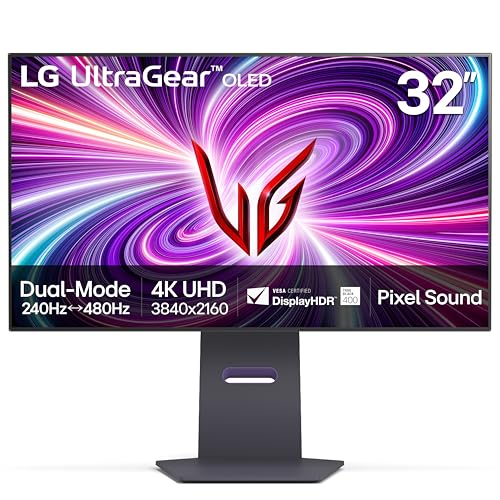
Premium Pick
LG UltraGear 32GS95UE OLED
A dual mode with 1080p at 480Hz at the highest price in the group.
Best for: Buyers for whom price is not the deciding factor.
Our take Check price for LG UltraGear 32GS95UE OLED (opens in a new tab)
| Pick | Why it’s here | Best for | Price |
|---|---|---|---|
| The highest refresh rate here (480Hz). | Esports players with a GPU that can feed high frame rates. | Check price for ASUS ROG Swift PG27AQDP (opens in a new tab) |
| A lower price than the PG27AQDP and the rest when we checked. | Keeping the budget tight. | Check price for MSI MPG 271QRX QD-OLED (opens in a new tab) |
| A built-in KVM with picture-in-picture. | Buyers who want built-in KVM with picture-in-picture. | Check price for MSI MPG 321URX QD-OLED (opens in a new tab) |
| A Glare Free coating Samsung lists as 54% less glossy than standard anti-reflection film. | Buyers who want Glare Free coating Samsung lists as 54% less glossy than standard anti-reflection film. | Check price for Samsung Odyssey OLED G8 G81SF 32-inch (opens in a new tab) |
| A dual mode with 1080p at 480Hz at the highest price in the group. | Buyers for whom price is not the deciding factor. | Check price for LG UltraGear 32GS95UE OLED (opens in a new tab) |
Our Picks
Fastest Refresh1 of 5
ASUS ROG Swift PG27AQDP on Amazon (opens in a new tab)
The PG27AQDP goes further to 480Hz on a WOLED panel, the fastest here, for players whose PCs can feed it.
Best for
- Esports players with a GPU that can feed high frame rates.
Skip if
- Pass on it if oLED burn-in risk with static desktop element rules it out for your setup.
Why we like it
Its 480Hz refresh rate is the highest here; the MPG 271QRX comes next at 360Hz. On screen size it trails the group at 26.5 inches, while the Odyssey G8 G81SF comes in at 32 inches. Like the MPG 271QRX, it has a 2560x1440 (1440p) resolution, while the Odyssey G8 G81SF uses a 3840x2160 (4K) resolution.
No other pick in this guide offers a WOLED panel; compare the Odyssey G8 G81SF, which has a QD-OLED panel. You get a G-SYNC Compatible here, which sets it apart from the 32GS95UE and its a FreeSync Premium Pro. To see 480Hz at 1440p, connect over DisplayPort or HDMI 2.1; older HDMI 2.0 ports cap the refresh rate lower.
Leave the maker's pixel-refresh routines enabled and hide static taskbars to limit burn-in risk. On price it sat second of 5, between the cheaper MPG 271QRX and the pricier MPG 321URX, at the time of writing.
Key dimensions & specs
- Refresh rate: 480Hz
- Resolution: 2560x1440 (1440p)
- Size: 26.5 inches
- Panel: WOLED
- Response: 0.03ms
- HDR: DisplayHDR True Black 400
- Color gamut: 99% DCI-P3
- Adaptive sync: G-SYNC Compatible
- Warranty: 3-year
Pros
- a 480Hz refresh rate for fast motion
- 1440p resolution, sharper than 1080p at 27 inches
- a WOLED panel with per-pixel contrast
- DisplayHDR True Black 400 certification
Cons
- OLED burn-in risk with static desktop elements
- Screen size trails the Odyssey G8 G81SF (32 inches)
- Costs more than the MPG 271QRX at the time of writing
Lowest Price Here2 of 5
MSI MPG 271QRX QD-OLED on Amazon (opens in a new tab)
The MPG 271QRX adds a KVM switch to a 360Hz QD-OLED panel with True Black 400.
Best for
- Keeping the budget tight.
Skip if
- Worth skipping when oLED burn-in risk with static desktop element is a problem.
Why we like it
Its built-in KVM switches a keyboard and mouse between two computers, and the stand adjusts for ergonomics. Its QD-OLED panel refreshes at 360Hz with a 0.03ms GtG response time. MSI rates its colour at Delta E 2 or below.
Its 360Hz refresh rate ranks second of 5 here, behind the PG27AQDP (480Hz) and ahead of the 32GS95UE (240Hz). On screen size it sits mid-pack at 27 inches: the Odyssey G8 G81SF comes in at 32 inches, and the PG27AQDP comes in at 26.5 inches. Like the PG27AQDP, it has a 2560x1440 (1440p) resolution, while the 32GS95UE uses a 3840x2160 (4K) resolution.
Like the MPG 321URX and Odyssey G8 G81SF, it has a QD-OLED panel, while the PG27AQDP uses a WOLED panel. You also get HDMI 2.1 inputs and an HDMI 2.1 input for consoles. It undercut the PG27AQDP and every other pick on price at the time of writing.
Key dimensions & specs
- Refresh rate: 360Hz
- Resolution: 2560x1440 (1440p)
- Size: 27 inches
- Panel: QD-OLED
- Response: 0.03ms
- HDR: DisplayHDR True Black 400
Pros
- a 360Hz refresh rate for fast motion
- 1440p resolution, sharper than 1080p at 27 inches
- a QD-OLED panel with per-pixel contrast
- DisplayHDR True Black 400 certification
Cons
- OLED burn-in risk with static desktop elements
- Refresh rate of 360Hz, behind the PG27AQDP (480Hz)
Also Consider3 of 5
MSI MPG 321URX QD-OLED on Amazon (opens in a new tab)
MSI's MPG 321URX is a 31.5-inch 4K QD-OLED at 240Hz with a built-in KVM, so one keyboard and mouse can switch between a desktop and a laptop.
Best for
- Buyers who want built-in KVM with picture-in-picture.
Skip if
- Worth skipping when oLED burn-in risk with static desktop element is a problem.
Why we like it
USB-C input rounds out the ports. It matches the Odyssey G8 G81SF and the 32GS95UE on refresh rate (240Hz). On screen size it sits mid-pack at 31.5 inches: the Odyssey G8 G81SF comes in at 32 inches, and the PG27AQDP comes in at 26.5 inches.
Like the Odyssey G8 G81SF and 32GS95UE, it has a 3840x2160 (4K) resolution, while the PG27AQDP uses a 2560x1440 (1440p) resolution. Like the MPG 271QRX and Odyssey G8 G81SF, it has a QD-OLED panel, while the PG27AQDP uses a WOLED panel. You also get HDMI 2.1 and DisplayPort 1.4a inputs and an HDMI 2.1 input for consoles.
Reaching 240Hz at 4K needs DisplayPort 1.4 with DSC or HDMI 2.1 on your graphics card, and a GPU able to render well above 100fps at 4K. On price it sat third of 5, between the cheaper PG27AQDP and the pricier Odyssey G8 G81SF, at the time of writing.
Key dimensions & specs
- Refresh rate: 240Hz
- Resolution: 3840x2160 (4K)
- Size: 31.5 inches
- Panel: QD-OLED
- Response: 0.03ms
- HDR: DisplayHDR True Black 400
- USB-C: Yes
Pros
- a 240Hz refresh rate for fast motion
- 4K resolution for sharp text and detail
- a QD-OLED panel with per-pixel contrast
- DisplayHDR True Black 400 certification
Cons
- OLED burn-in risk with static desktop elements
- Costs more than the MPG 271QRX at the time of writing
Strong Alternative4 of 5
Samsung Odyssey OLED G8 G81SF 32-inch on Amazon (opens in a new tab)
Samsung's G81SF puts a 240Hz QD-OLED panel at 4K into a 32-inch screen.
Best for
- Buyers who want Glare Free coating Samsung lists as 54% less glossy than standard anti-reflection film.
Skip if
- Pass on it if oLED burn-in risk with static desktop element rules it out for your setup.
Why we like it
Its Glare Free coating cuts reflections that glossy OLEDs show in bright rooms, and it detects logos and taskbars to dim them. It matches the MPG 321URX and the 32GS95UE on refresh rate (240Hz). On screen size it ties with the 32GS95UE at 32 inches.
Like the MPG 321URX and 32GS95UE, it has a 3840x2160 (4K) resolution, while the PG27AQDP uses a 2560x1440 (1440p) resolution. Like the MPG 271QRX and MPG 321URX, it has a QD-OLED panel, while the PG27AQDP uses a WOLED panel. You also get a Glare Free coating Samsung lists as 54% less glossy than standard anti-reflection film and logo and taskbar detection to dim static elements.
Reaching 240Hz at 4K needs DisplayPort 1.4 with DSC or HDMI 2.1 on your graphics card, and a GPU able to render well above 100fps at 4K. On price it sat fourth of 5, between the cheaper MPG 321URX and the pricier 32GS95UE, at the time of writing.
Key dimensions & specs
- Refresh rate: 240Hz
- Resolution: 3840x2160 (4K)
- Size: 32 inches
- Panel: QD-OLED
- Response: 0.03ms
- HDR: DisplayHDR True Black 400
- Adaptive sync: G-SYNC Compatible, FreeSync Premium Pro
Pros
- a 240Hz refresh rate for fast motion
- 4K resolution for sharp text and detail
- a QD-OLED panel with per-pixel contrast
- DisplayHDR True Black 400 certification
Cons
- OLED burn-in risk with static desktop elements
- Costs more than the MPG 271QRX at the time of writing
Premium Pick5 of 5
LG UltraGear 32GS95UE OLED on Amazon (opens in a new tab)
LG's 32GS95UE is a 32-inch 4K OLED at 240Hz with FreeSync Premium Pro.
Best for
- Buyers for whom price is not the deciding factor.
Skip if
- Choose another pick if you can't accept this: oLED burn-in risk with static desktop elements.
Why we like it
It is the most expensive 4K OLED here at the time of writing. On refresh rate it ties with the MPG 321URX and the Odyssey G8 G81SF at 240Hz. It matches the Odyssey G8 G81SF on screen size (32 inches).
It shares a 3840x2160 (4K) resolution with the MPG 321URX and Odyssey G8 G81SF; the MPG 271QRX goes with a 2560x1440 (1440p) resolution. An OLED panel is unique to it among these picks, while the MPG 271QRX uses a QD-OLED panel. No other pick in this guide offers a FreeSync Premium Pro; compare the PG27AQDP, which has a G-SYNC Compatible.
It also comes with a dual mode with 1080p at 480Hz and an HDMI 2.1 input. At our last price check it topped the group, with the Odyssey G8 G81SF the nearest cheaper option. Refresh rate is its weakest area, and the PG27AQDP covers it better at 480Hz.
Key dimensions & specs
- Refresh rate: 240Hz
- Resolution: 3840x2160 (4K)
- Size: 32 inches
- Panel: OLED
- Response: 0.03ms
- HDR: DisplayHDR True Black 400
- Adaptive sync: FreeSync Premium Pro
Pros
- a 240Hz refresh rate for fast motion
- 4K resolution for sharp text and detail
- a OLED panel with per-pixel contrast
- DisplayHDR True Black 400 certification
Cons
- OLED burn-in risk with static desktop elements
- Refresh rate trails the PG27AQDP (480Hz)
- Costs more than the MPG 271QRX at the time of writing
How We Chose These 240Hz OLED Gaming Monitors
Each pick was assessed across 4 criteria weighted for real-world use.
- The figures behind the order
- We set side by side five monitors on refresh rate, resolution, screen size and panel, using each maker's published specs. We did not test them in-house.
- What every pick has in common
- All 5, from the PG27AQDP to the 32GS95UE, state refresh rate, resolution and screen size and share 0.03ms response and DisplayHDR True Black 400 HDR.
- Where the specs have gaps
- The MPG 271QRX and the MPG 321URX give no adaptive sync.
- Price range
- At our last check the picks ran from the MPG 271QRX ($500 to $1000) to the 32GS95UE ($1000 to $1500).
What to Look for in a 240Hz OLED Gaming Monitor
Key buying criteria so you get the right fit the first time.
Refresh rate across these picks
Here refresh rate runs from 240Hz on the 32GS95UE to 480Hz on the PG27AQDP. The MPG 271QRX comes second for less money.
How much screen size you need
Here screen size runs from 26.5 inches on the PG27AQDP to 32 inches on the Odyssey G8 G81SF. The Odyssey G8 G81SF is the pick for screen size.
Panel
The PG27AQDP lists WOLED; the MPG 271QRX, the MPG 321URX and the Odyssey G8 G81SF list QD-OLED; the 32GS95UE lists OLED. Rule out the mismatches before looking at price.
Extras that separate them
The MPG 321URX: HDMI 2.1 and DisplayPort 1.4a inputs. The Odyssey G8 G81SF: logo and taskbar detection to dim static elements. The 32GS95UE: an HDMI 2.1 input.
How much to spend
$500 to $1000 buys the MPG 271QRX, the PG27AQDP, the MPG 321URX and the Odyssey G8 G81SF; $1000 to $1500 buys the 32GS95UE at our last check.
How to Choose a 240Hz OLED Gaming Monitor
By priority
| Priority | Consider | Why |
|---|---|---|
| Esports players with a GPU that can feed high frame rates | PG27AQDP | The highest refresh rate here (480Hz) |
| Keeping the budget tight | MPG 271QRX | A lower price than the PG27AQDP and the rest when we checked |
| Buyers who want built-in KVM with picture-in-picture | MPG 321URX | A built-in KVM with picture-in-picture |
| Buyers who want Glare Free coating Samsung lists as 54% less glossy than standard anti-reflection film | Odyssey G8 G81SF | A Glare Free coating Samsung lists as 54% less glossy than standard anti-reflection film |
| Buyers for whom price is not the deciding factor | 32GS95UE | A dual mode with 1080p at 480Hz at the highest price in the group |
Scroll sideways to see every column.
Key specs side by side
The PG27AQDP leads on refresh rate at 480Hz, ahead of the MPG 271QRX at 360Hz.
| Monitor | Refresh rate | Resolution | Size | Panel |
|---|---|---|---|---|
| PG27AQDP | 480Hz | 2560x1440 (1440p) | 26.5 inches | WOLED |
| MPG 271QRX | 360Hz | 2560x1440 (1440p) | 27 inches | QD-OLED |
| MPG 321URX | 240Hz | 3840x2160 (4K) | 31.5 inches | QD-OLED |
| Odyssey G8 G81SF | 240Hz | 3840x2160 (4K) | 32 inches | QD-OLED |
| 32GS95UE | 240Hz | 3840x2160 (4K) | 32 inches | OLED |
Scroll sideways to see every column.
By price at the time of writing
The MPG 271QRX was the lowest-priced pick and the 32GS95UE the highest when we checked; tiers move with Amazon pricing.
| Price tier | Monitors |
|---|---|
| About $500 to $1000 | MPG 271QRX, PG27AQDP, MPG 321URX, Odyssey G8 G81SF |
| About $1000 to $1500 | 32GS95UE |
Frequently Asked Questions
How does the MPG 271QRX compare with the PG27AQDP on refresh rate?
The PG27AQDP leads at 480Hz, with the MPG 271QRX at 360Hz. The 32GS95UE is at the other end of this group with 240Hz.
What does the 32GS95UE add over the MPG 271QRX?
On paper it adds screen size (32 inches against 27 inches). It does not win everywhere: the MPG 271QRX still leads on refresh rate (360Hz). The MPG 271QRX was the lowest-priced pick when we checked, so pay the difference only if those gains matter to you.
Why is the PG27AQDP our Fastest Refresh pick?
It earns the label for the highest refresh rate here (480Hz). It suits esports players with a GPU that can feed high frame rates.
Do the PG27AQDP and the MPG 321URX differ on resolution?
The PG27AQDP and the MPG 271QRX use 2560x1440 (1440p); the MPG 321URX, the Odyssey G8 G81SF and the 32GS95UE use 3840x2160 (4K).
What extras do the PG27AQDP and the MPG 271QRX include?
The PG27AQDP: a 480Hz refresh rate at 1440p. The MPG 271QRX: a built-in KVM switch. The MPG 321URX: a built-in KVM with picture-in-picture.
Bottom Line
Our first pick is the PG27AQDP. Look at the MPG 271QRX for a lower price than the PG27AQDP and the rest when we checked, the MPG 321URX for a built-in KVM with picture-in-picture and the Odyssey G8 G81SF for a Glare Free coating Samsung lists as 54% less glossy than standard anti-reflection film if those matter more to you.
Keep brightness moderate and use the monitor's pixel refresh features.