
Buying Guide
The Best AMD GPUs
Five graphics cards ranked on video memory and card length, where the ASRock RX 9060 XT Challenger 16GB has the lowest recommended power supply, and it also costs the least.
By The PC Journal editorial team
12 min read5 products evaluated
AMD cards give more video memory per dollar than most rivals. Every pick is a Radeon RX card that cost $300 or more, ordered by memory size.
We ranked these graphics cards on GPU, VRAM and memory using manufacturer specifications; where a maker leaves out length, we say so rather than guess, since we have not benched them.
Quick Picks
Our 5 recommendations at a glance. Tap a pick for the full verdict.

Also Consider
ASRock Radeon RX 7900 XTX Phantom Gaming OC 24GB
96MB of Infinity Cache.
Best for: Buyers who want 96MB of Infinity Cache.
Our take Check price for ASRock Radeon RX 7900 XTX Phantom Gaming OC 24GB (opens in a new tab)

Premium Pick
PowerColor Hellhound AMD Radeon RX 7900 XTX
The top of this price range, adding DisplayPort 2.1 outputs.
Best for: Spending more for the fullest feature set.
Our take Check price for PowerColor Hellhound AMD Radeon RX 7900 XTX (opens in a new tab)
Strong Alternative
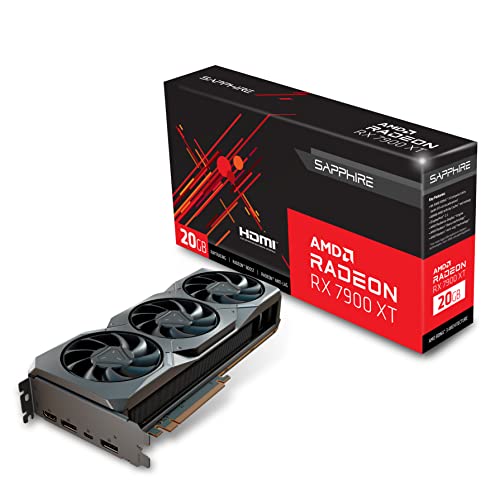
Sapphire AMD Radeon RX 7900 XT 20GB
A USB-C display output.
Best for: Buyers who want USB-C display output.
Our take Check price for Sapphire AMD Radeon RX 7900 XT 20GB (opens in a new tab)

Worth a Look
PowerColor AMD Radeon RX 7900 XT
A 750W minimum PSU stated by the maker.
Best for: Buyers who want 750W minimum PSU stated by the maker.
Our take Check price for PowerColor AMD Radeon RX 7900 XT (opens in a new tab)

Lowest Recommended Power Supply
ASRock Radeon RX 9060 XT Challenger 16GB OC
The lowest recommended power supply here (550W).
Best for: Buyers who put recommended power supply first.
Our take Check price for ASRock Radeon RX 9060 XT Challenger 16GB OC (opens in a new tab)
Our Picks
Also Consider1 of 5
ASRock Radeon RX 7900 XTX Phantom Gaming OC 24GB on Amazon (opens in a new tab)
ASRock's Phantom Gaming OC offers a 2615MHz boost, 96MB of Infinity Cache and 0dB silent cooling at light load.
Best for
- Buyers who want 96MB of Infinity Cache.
Skip if
- Worth skipping when calls for a 800W or larger PS is a problem.
Why we like it
It was the least expensive 7900 XTX here at the time of writing. It boosts to 2615MHz with 24GB of GDDR6, 96 compute units and 96MB of Infinity Cache. The Phantom Gaming triple-fan cooler sits on a reinforced metal frame.
On video memory it ties with the PowerColor Hellhound 7900 XTX at 24GB. On recommended power supply it ties with the PowerColor Hellhound 7900 XTX at 800W. No other pick in this guide offers a 2615MHz boost clock; compare the PowerColor 7900 XT, which has a 2400MHz boost clock.
No dimensions are published for the ASRock 7900 XTX Phantom Gaming; get length and thickness from the maker's page first. It was priced above the PowerColor 7900 XT and below the PowerColor Hellhound 7900 XTX at the time of writing. There is no published card length figure, whereas the ASRock RX 9060 XT Challenger 16GB comes in at 249mm.
Key dimensions & specs
- GPU: RX 7900 XTX
- VRAM: 24GB
- Memory: GDDR6
- Recommended PSU: 800W
- Boost clock: 2615MHz
Pros
- 24GB of VRAM, room for large local AI models as well as games
- 96MB of Infinity Cache
- 0dB silent cooling at light load
- 2615MHz boost clock, the only one here
Cons
- Calls for a 800W or larger PSU
- Costs more than the ASRock RX 9060 XT Challenger 16GB at the time of writing
Premium Pick2 of 5
PowerColor Hellhound AMD Radeon RX 7900 XTX on Amazon (opens in a new tab)
PowerColor's Hellhound is 320mm long, uses DisplayPort 2.1 outputs and states an 800W minimum power supply.
Best for
- Spending more for the fullest feature set.
Skip if
- Worth skipping when calls for a 800W or larger PS is a problem.
Why we like it
It has 6,144 stream processors and a switch between an OC mode at 2,330MHz and a quieter Silent mode at 2,270MHz game clock. The Silent mode suits a quiet room. The card measures 320 x 118.5 x 62mm, so check case clearance first.
It carries 24GB of GDDR6 and 6144 stream processors. On video memory it ties with the ASRock 7900 XTX Phantom Gaming at 24GB. It shares an RX 7900 XTX gpu with the ASRock 7900 XTX Phantom Gaming; the ASRock RX 9060 XT Challenger 16GB goes with an RX 9060 XT gpu.
The PowerColor Hellhound 7900 XTX is 320mm long; compare that with your case's GPU limit. At our last price check it topped the group, with the ASRock 7900 XTX Phantom Gaming the nearest cheaper option. If you want a confirmed cooler thickness, look to the ASRock RX 9060 XT Challenger 16GB instead: it comes in at 2-slot, while this one gives no figure.
Key dimensions & specs
- GPU: RX 7900 XTX
- VRAM: 24GB
- Memory: GDDR6
- Length: 320mm
- Recommended PSU: 800W
- Outputs: 3 x DisplayPort 2.1, 1 x HDMI 2.1
Pros
- 24GB of VRAM, room for large local AI models as well as games
- DisplayPort 2.1 outputs
- 800W minimum PSU stated by the maker
- The top of this price range, adding DisplayPort 2.1 outputs
Cons
- Calls for a 800W or larger PSU
- Recommended power supply trails the ASRock RX 9060 XT Challenger 16GB (550W)
- Costs more than the ASRock RX 9060 XT Challenger 16GB at the time of writing
Strong Alternative3 of 5
Sapphire AMD Radeon RX 7900 XT 20GB on Amazon (opens in a new tab)
Sapphire's 7900 XT keeps a USB-C display output alongside two DisplayPort and one HDMI port on a 3-slot cooler.
Best for
- Buyers who want USB-C display output.
Skip if
- Worth skipping when its 3-slot cooler covers the slots belo is a problem.
Why we like it
Its 320-bit memory interface feeds 20GB of VRAM, and it takes three slots. It uses PCIe 4.0 and takes three slots, so check your case clearance. It matches the PowerColor 7900 XT on video memory (20GB).
Like the PowerColor 7900 XT, it has an RX 7900 XT gpu, while the PowerColor Hellhound 7900 XTX uses an RX 7900 XTX gpu. The Sapphire 7900 XT occupies 3 slots, but no length is published, so check the maker's spec page against your case. Its power connector and recommended PSU are not published, so confirm both for the Sapphire 7900 XT with the maker.
On price it sat second of 5, between the cheaper ASRock RX 9060 XT Challenger 16GB and the pricier PowerColor 7900 XT, at the time of writing. The maker doesn't give its card length; if that figure matters, the ASRock RX 9060 XT Challenger 16GB comes in at 249mm.
Key dimensions & specs
- GPU: RX 7900 XT
- VRAM: 20GB
- Memory: GDDR6
- Thickness: 3-slot
- Outputs: 2 x DisplayPort, 1 x HDMI, 1 x USB-C
Pros
- 20GB of VRAM for high-resolution textures
- USB-C display output
- 3-slot reference-style cooler
Cons
- Its 3-slot cooler covers the slots below
- No published recommended power supply
- Costs more than the ASRock RX 9060 XT Challenger 16GB at the time of writing
Worth a Look4 of 5
PowerColor AMD Radeon RX 7900 XT on Amazon (opens in a new tab)
PowerColor's 7900 XT runs AMD's reference 2400MHz boost and states a 750W minimum power supply.
Best for
- Buyers who want 750W minimum PSU stated by the maker.
Skip if
- Price-first buyers should look at the ASRock RX 9060 XT Challenger 16GB, which cost less when we checked.
Why we like it
On video memory it ties with the Sapphire 7900 XT at 20GB. On recommended power supply it sits mid-pack at 750W: the ASRock RX 9060 XT Challenger 16GB offers 550W, and the PowerColor Hellhound 7900 XTX comes in at 800W. It is the only pick here with a 2400MHz boost clock; the ASRock 7900 XTX Phantom Gaming has a 2615MHz boost clock instead.
No dimensions are published for the PowerColor 7900 XT; get length and thickness from the maker's page first. PowerColor 7900 XT: the maker suggests a PSU of 750W or more. When we checked, only the Sapphire 7900 XT and cheaper picks cost less, and the ASRock 7900 XTX Phantom Gaming cost more. If you want a confirmed card length, look to the ASRock RX 9060 XT Challenger 16GB instead: it comes in at 249mm, while this one gives no figure.
Key dimensions & specs
- GPU: RX 7900 XT
- VRAM: 20GB
- Memory: GDDR6
- Recommended PSU: 750W
- Boost clock: 2400MHz
Pros
- 20GB of VRAM for high-resolution textures
- 750W minimum PSU stated by the maker
- Reference 2400MHz boost clock
- Recommended power supply of 750W, ahead of the ASRock 7900 XTX Phantom Gaming
Cons
- Costs more than the ASRock RX 9060 XT Challenger 16GB at the time of writing
Lowest Recommended Power Supply5 of 5
ASRock Radeon RX 9060 XT Challenger 16GB OC on Amazon (opens in a new tab)
ASRock's Challenger gives the RX 9060 XT a full 16GB of memory in a two-slot, 249mm card.
Best for
- Buyers who put recommended power supply first.
Skip if
- Skip it if video memory matters most to you; the ASRock 7900 XTX Phantom Gaming offers 24GB.
Why we like it
The maker offers a 550W power supply and a single 8-pin plug, so it drops into most existing builds. On video memory it trails the group at 16GB, while the ASRock 7900 XTX Phantom Gaming offers 24GB. On recommended power supply it leads this guide at 550W, ahead of the PowerColor 7900 XT (750W).
An RX 9060 XT gpu is unique to it among these picks, while the PowerColor Hellhound 7900 XTX uses an RX 7900 XTX gpu. No other pick in this guide offers a 3290MHz boost clock; compare the ASRock 7900 XTX Phantom Gaming, which has a 2615MHz boost clock. It also comes with 32 compute units and 0dB fan stop at light load.
Power for the ASRock RX 9060 XT Challenger 16GB comes through 1 x 8-pin, with 550W the maker's minimum PSU. It cost the least of the 5 picks at the time of writing, with the Sapphire 7900 XT the next step up.
Key dimensions & specs
- GPU: RX 9060 XT
- VRAM: 16GB
- Memory: GDDR6
- Length: 249mm
- Thickness: 2-slot
- Recommended PSU: 550W
- Power connector: 1 x 8-pin
- Boost clock: 3290MHz
Pros
- 16GB of VRAM for high-resolution textures
- Short 249mm length suits compact cases
- Dual-slot cooler leaves the next slot free
- A modest 550W PSU recommendation
Cons
- Video memory trails the ASRock 7900 XTX Phantom Gaming (24GB)
How We Chose
Each pick was assessed across 4 criteria weighted for real-world use.
- What we compared
- We lined up five cards on GPU, video memory, memory and card length, using each maker's published specs. We did not test them in-house.
- What every pick has in common
- All 5, from the ASRock 7900 XTX Phantom Gaming to the ASRock RX 9060 XT Challenger 16GB, state GPU, video memory and memory and share GDDR6 memory.
- Where the specs have gaps
- The ASRock 7900 XTX Phantom Gaming, the Sapphire 7900 XT and the PowerColor 7900 XT give no card length; the ASRock 7900 XTX Phantom Gaming, the PowerColor Hellhound 7900 XTX and the PowerColor 7900 XT give no cooler thickness.
- Price range
- At our last check the picks ran from the ASRock RX 9060 XT Challenger 16GB ($500 to $1000) to the PowerColor Hellhound 7900 XTX ($1000 to $1500).
What to Look for in an AMD GPUs
Key buying criteria so you get the right fit the first time.
How much video memory you need
Here video memory runs from 16GB on the ASRock RX 9060 XT Challenger 16GB to 24GB on the ASRock 7900 XTX Phantom Gaming. Start with the ASRock 7900 XTX Phantom Gaming if video memory decides it.
Recommended power supply
Here recommended power supply runs from 800W on the PowerColor Hellhound 7900 XTX to 550W on the ASRock RX 9060 XT Challenger 16GB. The ASRock RX 9060 XT Challenger 16GB is the pick for recommended power supply. No figure for the Sapphire 7900 XT.
Card length across these picks
Here card length runs from 320mm on the PowerColor Hellhound 7900 XTX to 249mm on the ASRock RX 9060 XT Challenger 16GB. Start with the ASRock RX 9060 XT Challenger 16GB if card length decides it. No figure for the ASRock 7900 XTX Phantom Gaming, the Sapphire 7900 XT and the PowerColor 7900 XT.
Boost clock
The ASRock 7900 XTX Phantom Gaming lists 2615MHz; the PowerColor 7900 XT lists 2400MHz; the ASRock RX 9060 XT Challenger 16GB lists 3290MHz.
Setup checks
No dimensions are published for the ASRock 7900 XTX Phantom Gaming; get length and thickness from the maker's page first. The PowerColor Hellhound 7900 XTX is 320mm long; compare that with your case's GPU limit. The Sapphire 7900 XT occupies 3 slots, but no length is published, so check the maker's spec page against your case.
How to Choose an AMD GPUs
By priority
| Priority | Consider | Why |
|---|---|---|
| Buyers who want 96MB of Infinity Cache | ASRock 7900 XTX Phantom Gaming | 96MB of Infinity Cache |
| Spending more for the fullest feature set | PowerColor Hellhound 7900 XTX | The top of this price range, adding DisplayPort 2.1 outputs |
| Buyers who want USB-C display output | Sapphire 7900 XT | A USB-C display output |
| Buyers who want 750W minimum PSU stated by the maker | PowerColor 7900 XT | A 750W minimum PSU stated by the maker |
| Buyers who put recommended power supply first | ASRock RX 9060 XT Challenger 16GB | The lowest recommended power supply here (550W) |
Scroll sideways to see every column.
Key specs side by side
The ASRock 7900 XTX Phantom Gaming leads on video memory at 24GB, ahead of the PowerColor Hellhound 7900 XTX at 24GB. "Not listed" means the maker leaves that figure out.
| Card | GPU | VRAM | Memory | Length |
|---|---|---|---|---|
| ASRock 7900 XTX Phantom Gaming | RX 7900 XTX | 24GB | GDDR6 | Not listed |
| PowerColor Hellhound 7900 XTX | RX 7900 XTX | 24GB | GDDR6 | 320mm |
| Sapphire 7900 XT | RX 7900 XT | 20GB | GDDR6 | Not listed |
| PowerColor 7900 XT | RX 7900 XT | 20GB | GDDR6 | Not listed |
| ASRock RX 9060 XT Challenger 16GB | RX 9060 XT | 16GB | GDDR6 | 249mm |
Scroll sideways to see every column.
By price at the time of writing
The ASRock RX 9060 XT Challenger 16GB was the lowest-priced pick and the PowerColor Hellhound 7900 XTX the highest when we checked; tiers move with Amazon pricing.
| Price tier | Cards |
|---|---|
| About $500 to $1000 | ASRock RX 9060 XT Challenger 16GB, Sapphire 7900 XT, PowerColor 7900 XT |
| About $1000 to $1500 | ASRock 7900 XTX Phantom Gaming, PowerColor Hellhound 7900 XTX |
Frequently Asked Questions
Which has the lowest recommended power supply: the ASRock RX 9060 XT Challenger 16GB or the PowerColor 7900 XT?
The ASRock RX 9060 XT Challenger 16GB comes out best at 550W, with the PowerColor 7900 XT at 750W. The PowerColor Hellhound 7900 XTX is at the other end of this group with 800W. The Sapphire 7900 XT doesn't state a figure, so it sits outside this comparison.
Is the ASRock RX 9060 XT Challenger 16GB ahead of the PowerColor Hellhound 7900 XTX on card length?
The ASRock RX 9060 XT Challenger 16GB comes out best at 249mm, with the PowerColor Hellhound 7900 XTX at 320mm. The ASRock 7900 XTX Phantom Gaming, the Sapphire 7900 XT and the PowerColor 7900 XT don't state a figure, so they sit outside this comparison.
Is the ASRock RX 9060 XT Challenger 16GB ahead of the Sapphire 7900 XT on cooler thickness?
The ASRock RX 9060 XT Challenger 16GB comes out best at 2-slot, with the Sapphire 7900 XT at 3-slot. The ASRock 7900 XTX Phantom Gaming, the PowerColor Hellhound 7900 XTX and the PowerColor 7900 XT don't state a figure, so they sit outside this comparison.
What does the PowerColor Hellhound 7900 XTX add over the ASRock RX 9060 XT Challenger 16GB?
On paper it adds video memory (24GB against 16GB). It does not win everywhere: the ASRock RX 9060 XT Challenger 16GB still leads on recommended power supply (550W) and card length (249mm). The ASRock RX 9060 XT Challenger 16GB was the lowest-priced pick when we checked, so pay the difference only if those gains matter to you.
Why is the ASRock RX 9060 XT Challenger 16GB our Lowest Recommended Power Supply pick?
It earns the label for the lowest recommended power supply here (550W). It suits anyone who put recommended power supply first.
Do the ASRock 7900 XTX Phantom Gaming and the Sapphire 7900 XT differ on GPU?
The ASRock 7900 XTX Phantom Gaming and the PowerColor Hellhound 7900 XTX use RX 7900 XTX; the Sapphire 7900 XT and the PowerColor 7900 XT use RX 7900 XT; the ASRock RX 9060 XT Challenger 16GB uses RX 9060 XT.
Bottom Line
Our first pick is the ASRock 7900 XTX Phantom Gaming, chosen for 96MB of Infinity Cache. Look at the PowerColor Hellhound 7900 XTX for the top of this price range, adding DisplayPort 2.1 outputs, the Sapphire 7900 XT for a USB-C display output and the PowerColor 7900 XT for a 750W minimum PSU stated by the maker if those matter more to you.
Check whether the driver software shows FSR options for your games.